
When to Call Tree Specialists: Signs Your Trees Need Professional Care
When a tree shows worrying signs—large trunk cracks, a sudden lean, fungal mushrooms at the base, or widespread canopy dieback—calling tree specialists is the safe, practical move. This post lays out clear, observable warning signs that warrant emergency response, an arborist assessment, or targeted services like cabling, pest treatment, and removal, and explains what to expect when you hire a professional such as Mr Tree Inc. You will get concrete thresholds for immediate versus routine work, the services to request, and realistic scheduling and cost expectations so you can decide with confidence.
Immediate hazards and when to call emergency tree services
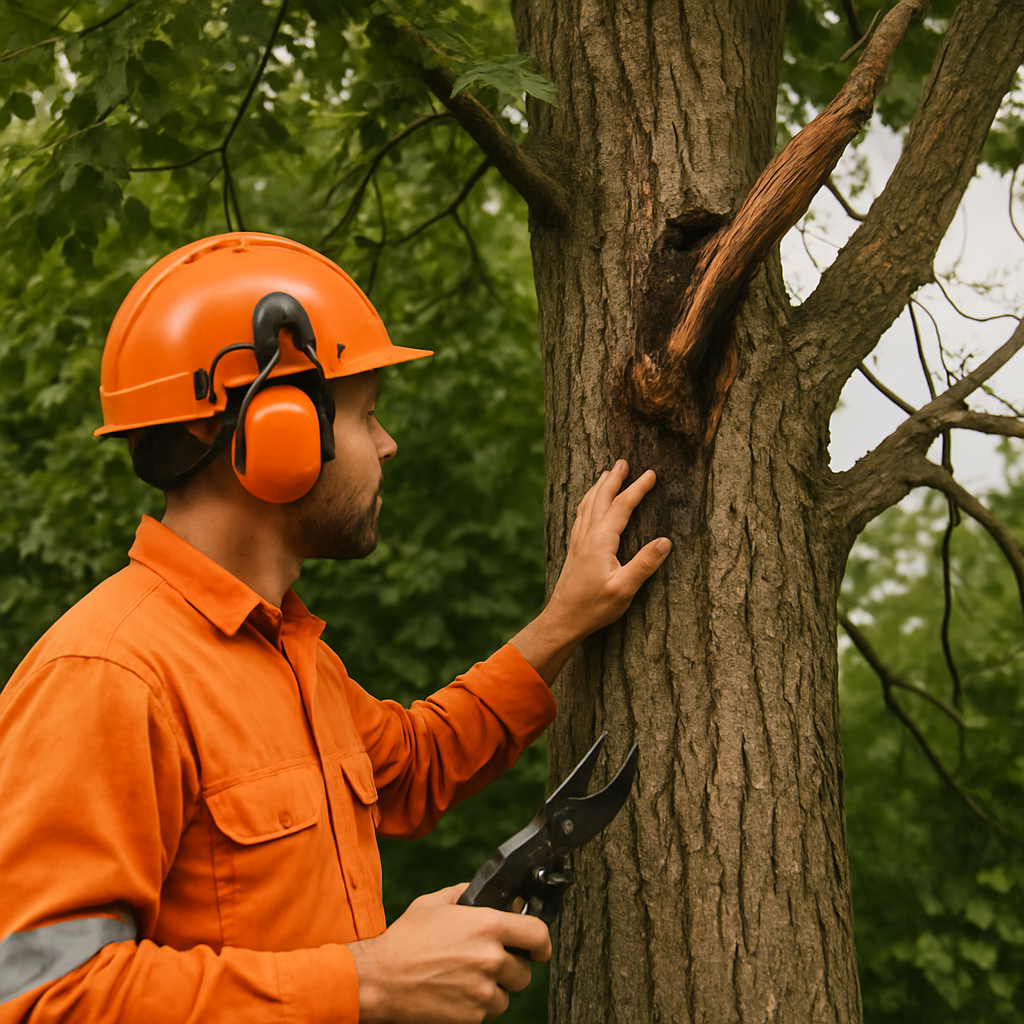
Immediate hazard means do not wait. Large fresh trunk splits, major limbs hanging by bark only, a tree that suddenly leans after wind or saturated soil, or visible root heave at the base are signals that the tree may fail without warning and require emergency tree services.
- Clear imminent failure signs: large longitudinal cracks, split crotches, or branches suspended over a house, vehicle, or walkway
- Utility contact: any branch or trunk touching power lines — contact your utility and then a tree service crew with utility coordination experience
- Access hazards: trees blocking roadways or emergency access, or trunks resting on structures
- Post storm movement: a tree that has shifted its lean angle or shows soil heave with exposed roots after a storm
What to tell the dispatcher when you call
Give concise, actionable details. Provide the exact property address, clear description of the hazard, whether the tree is contacting power lines, proximity to buildings or vehicles, and whether anyone is injured or trapped. If safe, include photos when you call. A good photo speeds response and triage.
Practical tradeoff to accept. Emergency removal is more expensive than scheduled work because crews mobilize quickly, may work in difficult conditions, and require extra safety measures. That cost has to be weighed against potential property damage, liability, and insurance claims which almost always make delay the costlier option.
Concrete example: After a summer storm a homeowner noticed a 40 foot maple with a new 20 degree lean and fresh root exposure on one side. The homeowner called emergency tree services; the crew stabilized hanging limbs to reduce immediate load, removed two hazardous scaffold limbs, and documented the condition for insurance. A follow up arborist assessment scheduled for the next day determined the tree needed full removal due to root plate compromise.
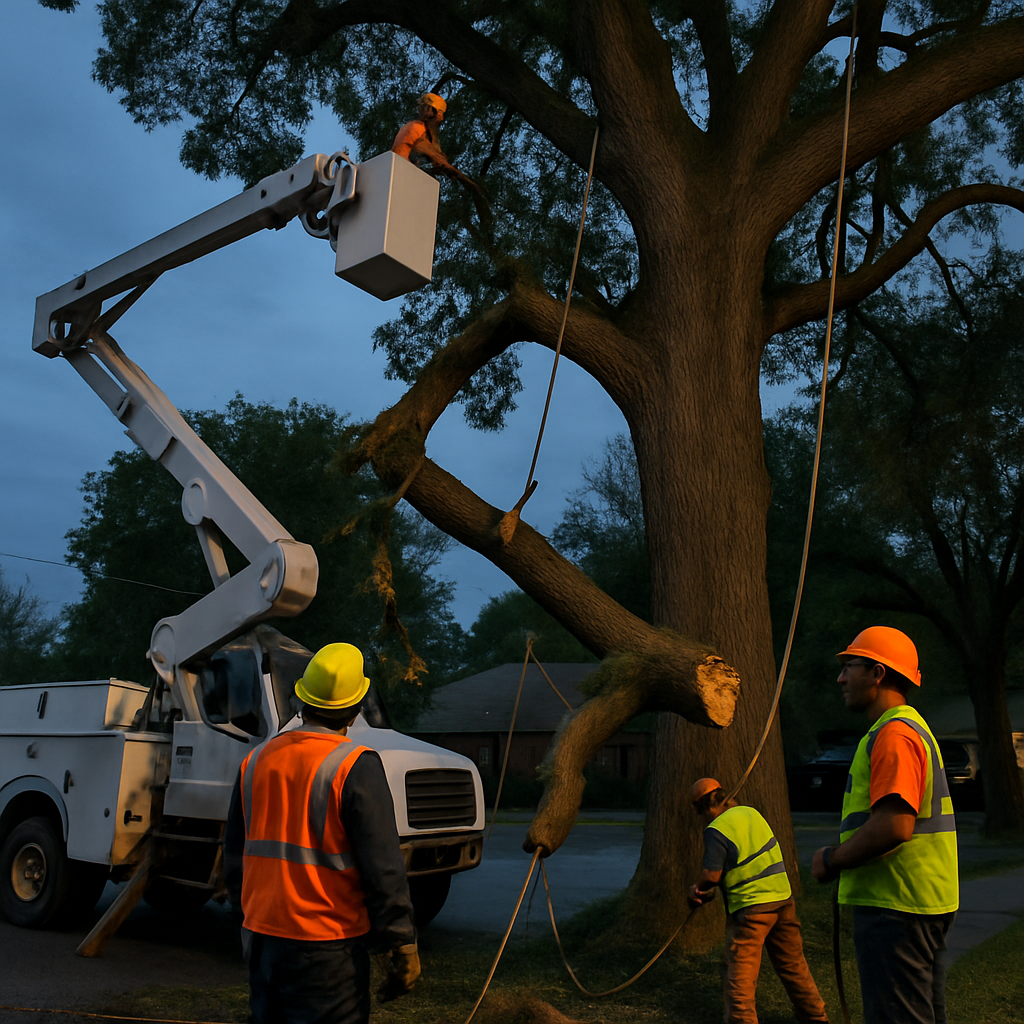
Common misunderstanding. People assume cutting the obvious hanging limb removes the risk. In practice a single cut can shift loads and cause unanticipated failures. Emergency crews use rigging, sectional removal, and sometimes temporary bracing to control where wood falls. Emergency work is often an initial fix followed by a full assessment and permanent repairs.
Emergency tree services typically provide triage, targeted limb removal, structural removals, temporary bracing or cabling, debris removal, and coordination with utilities or permitting when needed. For scheduled follow up work such as complete removal, stump grinding, or a written tree health assessment, see services and tree removal.
Trunk and structural defects that require an arborist assessment
Key point: Visible trunk defects are not a DIY judgment call. Small surface symptoms can hide major internal decay, and the decision to preserve versus remove has safety, budget, and long term maintenance consequences that are best resolved by tree specialists.
Common trunk and structural defects to watch for
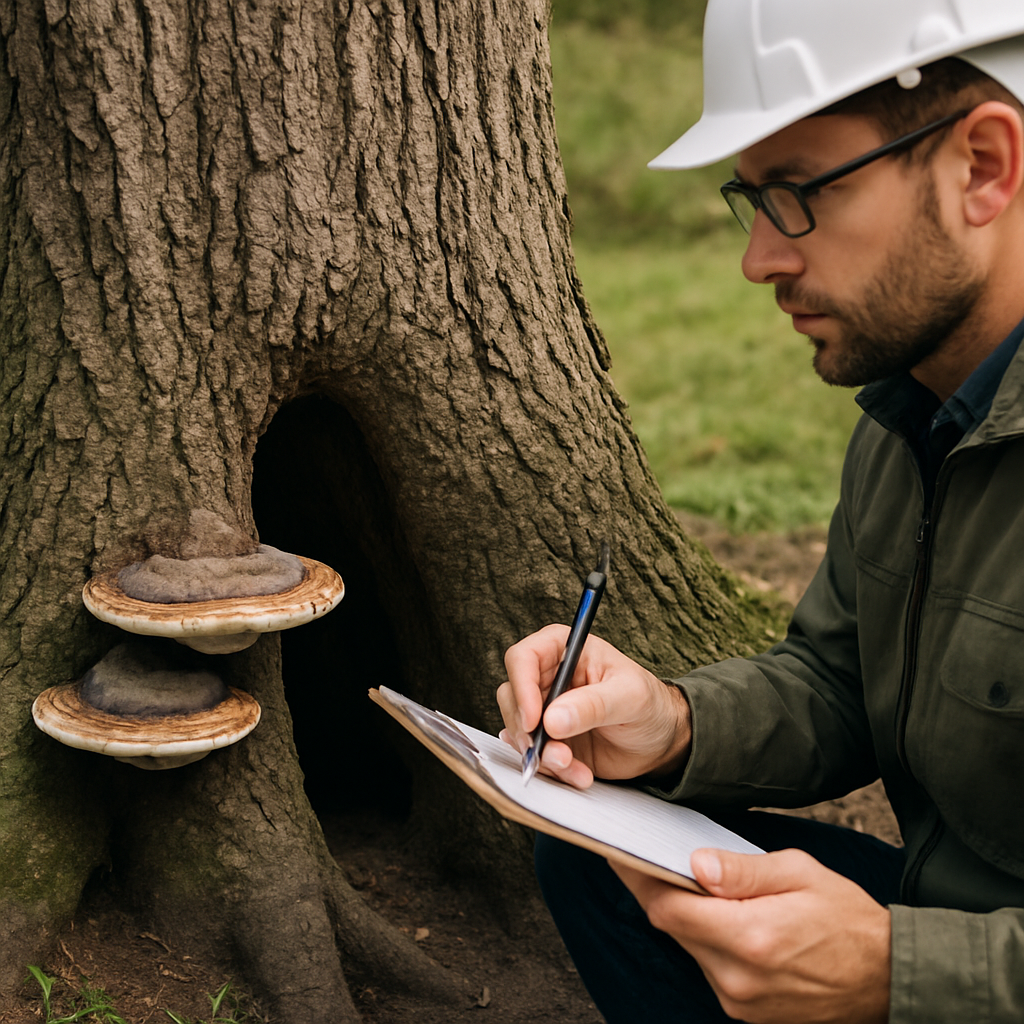
- Fungal fruiting bodies at the base – Mushrooms or bracket conks at the root collar almost always indicate internal wood decay and need a tree health assessment rather than a walk-by inspection.
- Longitudinal cracks and splits – Fresh, growing cracks or old healed splits can both undermine load paths; the location and depth determine whether cabling or removal is appropriate.
- Cavities and decay pockets – Hollows under bark or large cavities are structural concerns even if the canopy looks healthy; sounding and decay mapping by an arborist reveal remaining sound wood.
- Codominant stems with included bark – Two equal stems forming a narrow V with bark trapped between them create a high failure risk and often require bracing or selective reduction.
- Root collar decay and root flares hidden by mulch – Rot at the base or mulch piled against bark accelerates decay that compromises the whole trunk.
Practical limitation: Cabling and bracing are stabilizing tools, not miracles. They buy time and reduce risk for trees that still have adequate sound wood and good root support. If decay exceeds a threshold, bracing increases maintenance cost without eliminating long term failure risk and removal will be recommended.
Common misjudgment: Homeowners often assume a full canopy means the trunk is sound. That is frequently false. Trees can maintain leaves while interior decay progresses for years. Call tree specialists for a proper hazard and decay evaluation instead of relying on foliage alone.
| Observed defect | Likely professional response | Typical urgency |
|---|---|---|
| Fungal conks at base | Detailed decay assessment, written recommendation, possible removal or monitoring | Schedule assessment within 48 to 72 hours |
| Large longitudinal crack in trunk | Risk assessment; temporary bracing or emergency removal depending on crack progression | Assess promptly; emergency if crack is actively opening |
| Codominant stems with included bark | Cabling/bracing or selective reduction to change load distribution | Routine to urgent depending on crown weight and location |
Concrete example: A 30 inch oak with several bracket fungi at the root flare and a 2 inch wide vertical crack in one face kept a healthy summer canopy. An arborist performed decay sounding and recommended cabling and a monitored removal timeline because the tree still had usable wood but sat near a driveway. That approach preserved the tree for a limited time while reducing immediate risk and spreading cost over years.
What to expect from tree specialists: Certified arborists will combine visual inspection, decay sounding, and written risk ratings. Expect a recommendation that clearly states whether the goal is preservation, staged removal, or immediate removal, and which services from Mr Tree Inc services apply.
For deeper guidance on decay signs and assessment protocols see the International Society of Arboriculture resources at ISA research reports and consider scheduling a formal tree health assessment or cabling evaluation with local arborist services such as Tree Trimming – Mr. Tree Inc..
Canopy symptoms that point to disease or pest problems
Canopy changes are often the first visible signal of a deeper problem — but they rarely tell the whole story. When you see patterns across the crown rather than an isolated dead branch, treat that as a flag to call tree specialists for a diagnostic assessment.
Common canopy indicators and what they usually mean
- Widespread thinning or progressive dieback: Loss of leaves across many main branches usually points to systemic stress – root failure, vascular disease, or aggressive pests rather than normal aging.
- Epicormic sprouts (water sprouts) on trunk and large limbs: Stress response often caused by root damage, severe pruning, or chronic decline; indicates the tree is reallocating resources and merits a root-to-crown inspection.
- Flagging on many branch tips at once: Abrupt, simultaneous leaf scorches or dead tips suggest vascular pathogens (for example oak wilt) or chemical/root issues rather than random storm breakage.
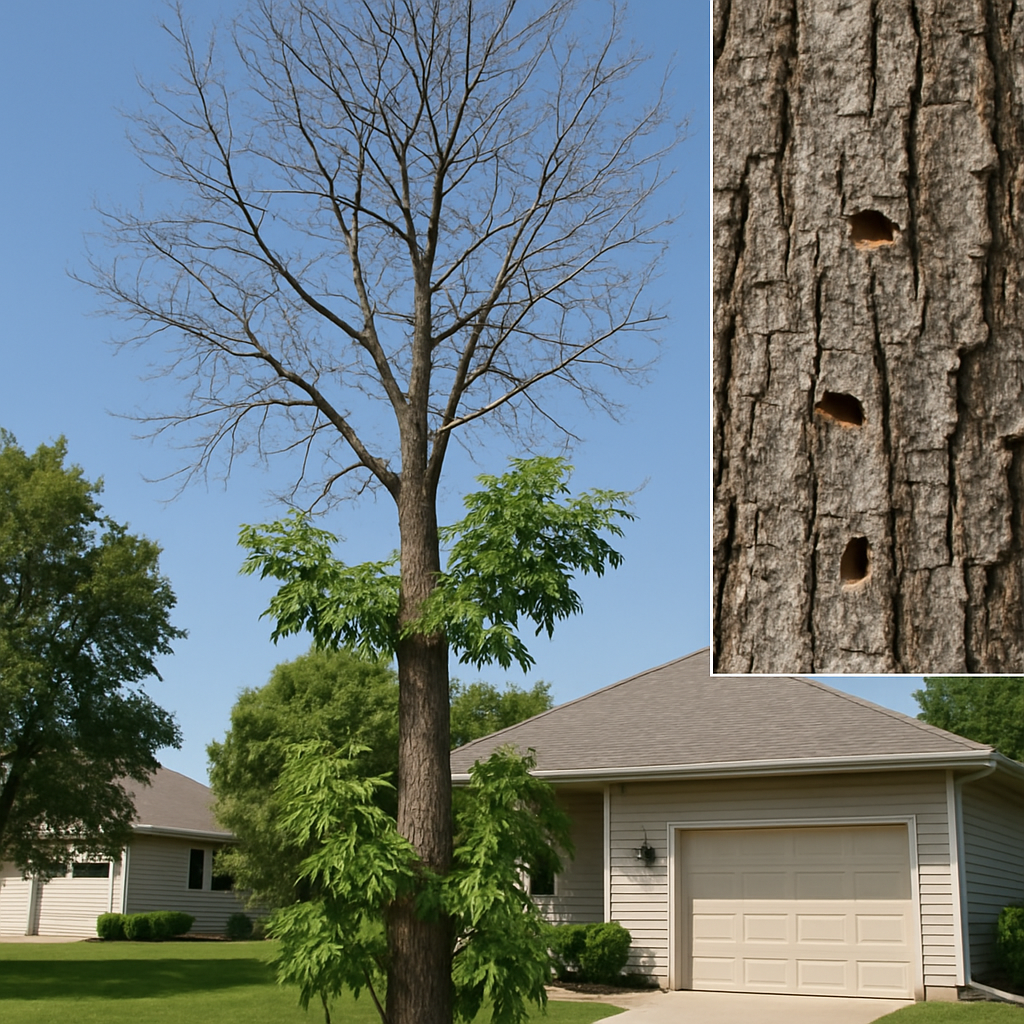
- Distinct feeding signs or frass: D-shaped exit holes, serpentine galleries, or sawdust-like frass point to borers such as emerald ash borer and need prompt specialist intervention to limit spread.
- Discolored, wilting leaves with vein banding or staining: Classic for fungal vascular diseases; lab confirmation or targeted sampling is often required before treatment choices are made.
- Clusters of dead leaves or single-branch crown death: Can be localized infection or included bark/codominant stem failure; an arborist will test whether pruning is sufficient or removal is safer.
Practical limitation: Canopy symptoms lag behind root and trunk failure.** A tree can look moderately stressed above while having severe root rot or a large decay pocket at the base. Tree specialists use canopy signs to triage the problem, then inspect the root collar, test for decay, or recommend lab tests to confirm diagnosis.
Concrete example: A homeowner noticed rapid decline in an ash crown with thinning and D-shaped holes in the bark. A field visit by tree care experts identified emerald ash borer infestation; the recommendation balanced the remaining live crown, treatment cost, and neighborhood spread risk, resulting in targeted removal of the worst specimens and chemical treatment for salvageable trees.
Trade-off to weigh: Treatments such as systemic injections or targeted pruning can preserve high-value trees but cost more and require correct timing; removal avoids future spread and liability but sacrifices the tree's benefits. The right move depends on tree value, extent of canopy loss, and local pest pressure.
When to call versus monitor: Arrange a tree health assessment if you see progressive canopy thinning, widespread epicormic sprouting, sudden multi-branch flagging, or signs of active borer activity. For a few isolated dead limbs, schedule routine pruning with a qualified crew such as our Tree Trimming – Mr. Tree Inc. team; for confirmed pests or rapid decline, contact tree specialists immediately.
Root health and soil signs that call for root management or specialist intervention
Key point: Root and soil problems are often the hidden cause when a healthy canopy collapses slowly. Visible signs at the trunk line or changes in the ground around a tree are not minor cosmetic issues; they are diagnostic clues that usually require root zone inspection by tree specialists rather than more pruning or surface fixes.
- Soil heave or cracking: raised ridges, split soil, or new depressions at the base after wind or saturation indicate root plate movement or failing anchorage
- Exposed or girdling roots: roots visible above the soil, roots wrapped around the trunk, or the trunk collar buried by fill greater than 2-3 inches often choke the tree and should prompt excavation
- Fungal fruiting bodies at the root collar: mushrooms or bracket fungi at the base mean decay in the root or lower stem and raise structural failure risk
- Persistent waterlogging or compacted soil: standing water, sealed surfaces near the root zone, or hard pan that prevents root oxygenation reduce root function even when irrigation is increased
- Repeated localized wilting despite watering: when single trees fail to respond to sensible irrigation, suspect root loss, root rot, or salt/chemical damage in the soil
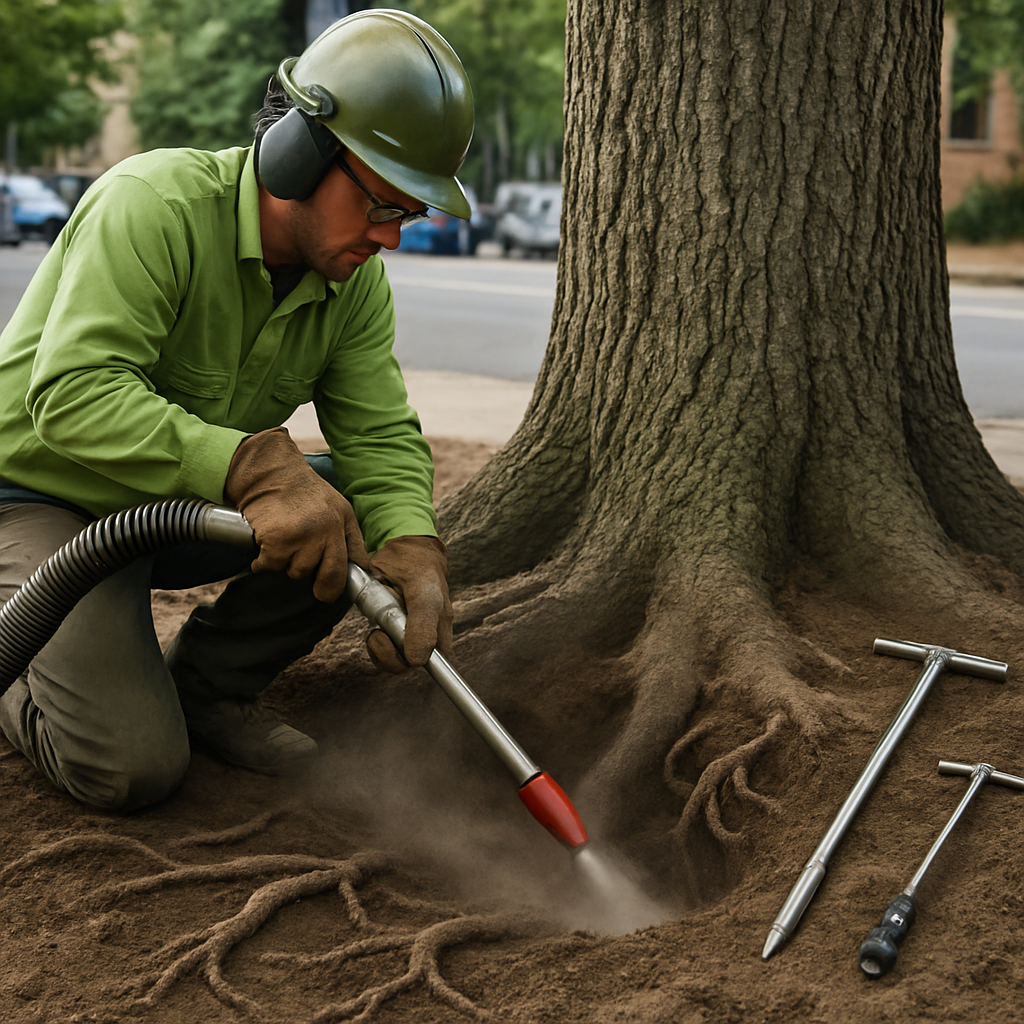
Practical tradeoff: Excavating the root collar to find the problem is the right diagnostic move but it is not benign. Mechanical digging will sever fine roots and increase stress. Use air spade excavation when possible; a progressive diagnostic approach preserves more roots and gives the specialist usable information.
What tree specialists do during a root and soil assessment
Assessment steps: certified arborists often combine visual signs with targeted tools – air spade excavation, probing for root decay, soil compaction tests, and simple percolation checks. They will map the root plate, inspect the root collar, and sample soil for salinity or nutrient imbalances when appropriate.
Intervention options: noninvasive fixes include targeted mulching, soil aeration, drainage correction, and organic soil amendments. More aggressive measures are structural root pruning, installation of root barriers, and limited regrading. If decay or loss of structural roots exceeds safe thresholds, removal may be the safest choice.
Limitation to accept: Root pruning or cutting large structural roots can reduce stability fast. Do not assume root pruning is neutral; removing more than a modest share of the major root mass will often require subsequent cabling, bracing, or removal to manage failure risk.
Concrete example: A 40 year old sugar maple lost significant feeder roots when a homeowner widened a driveway. Symptoms showed up as branch dieback and early fall color. An arborist used an air spade to expose the root crown, applied targeted mulching and soil amendments, and installed a protective mulch and barrier zone around the remaining roots. The tree recovered over two seasons but required follow up monitoring and an adjusted irrigation plan.
Judgment call: If the suspect issue is purely surface compaction and the tree is otherwise vigorous, inexpensive aeration and mulch may suffice. If there is evidence of root decay or structural root loss, do not delay. Early specialist diagnosis is cheaper and safer than reacting after a tree loses stability.
Next consideration: When root problems are suspected, prioritize a specialist root collar inspection and soil compaction test before scheduling any major pruning or installation work near the tree.
Storm damage, after action triage, and scheduling emergency versus routine service
Immediate triage is about prioritization, not fixing everything at once. After a storm, a professional crew will sort trees into three practical buckets – immediate risk requiring emergency crews, salvageable trees that need rapid but non emergent care, and trees that can wait for routine service and monitoring.
Practical triage steps used by tree specialists
- Secure the site: cordon off zones, avoid working under hanging debris, and photograph conditions for insurance.
- Stabilize first: remove hangers and loose material that threaten people or structures before any major cut work.
- Prioritize by consequence: give emergency crews jobs that reduce liability and restore access; schedule routine crews for non threat cleanup.
- Document and plan: record visible damage, note possible hidden root or trunk problems, and set follow up inspection windows.
Tradeoff to accept: emergency response costs more and is about immediate safety and access. Routine service is cheaper but can leave hidden defects untreated.** If a crew is dispatched for an emergency call they will apply temporary measures that reduce immediate risk, then schedule a more thorough assessment or preservation work later. That two step workflow costs more overall but reduces the chance of an unsafe partial fix.
Scheduling reality: expect emergency crews to arrive same day or within 24 hours in a typical service area, but during widespread storms wait times lengthen. For non urgent but time sensitive damage schedule a post storm assessment within 24 to 72 hours; routine pruning or removal can often be booked within 1 to 3 weeks depending on season and permit needs.
Permits and utilities slow work down. If the tree contacts public utilities or requires a municipal permit removal can be delayed for coordination. That is a scheduling constraint you cannot waive; budget for permit lead time and utility locate fees when you ask for service.
Concrete example: After a spring wind event a large maple had multiple cracked scaffold limbs but was still standing. A certified crew removed the immediate hangers and shredded debris for safe access, installed temporary cabling on a cracked union, and booked a full structural assessment the next week. Two weeks later the assessment showed root plate movement and the tree was removed under a scheduled removal slot with stump grinding arranged at the same visit.
Key judgement: if a tree can be stabilized safely by removing loose material and scheduling follow up, choose staged intervention. If public safety or utilities are affected, call emergency tree service now and expect premium scheduling and coordination work.
For service options see emergency and routine offerings from Mr Tree Inc at services – Mr. Tree Inc. and refer to guidance from the International Society of Arboriculture when you need technical background for insurance or permitting.
Maintenance thresholds where professional pruning or preservation is recommended
Large pruning tasks are a professional job once size, height, proximity, or preservation goals create safety or biological risk. If a pruning cut will remove more than about 25 to 30 percent of live crown, requires aerial access above 20 feet, or needs complex rigging near structures or utilities, call tree specialists rather than attempting a DIY job.
- Diameter threshold: Remove or reduce limbs larger than 5 to 6 inches in diameter only with professional equipment and techniques to avoid tear out and decay.
- Height threshold: Work above 20 feet usually requires rope access, lifts, or cranes and a certified crew.
- Crown reduction limits: Reductions greater than 25 to 30 percent of live crown change the tree architecture and need an arborist plan to avoid long term decline.
- Proximity triggers: Any work closer than 10 feet to a building, closer than 15 feet to overhead utilities, or within public right of way should be handled by licensed tree specialists and coordinated with utilities.
- Value and species sensitivity: High value trees, specimen oaks, fruit trees, and species prone to disease need targeted pruning plans or fertilization done by tree care experts and certified arborists.
Tradeoff to accept: Hiring specialists costs more up front but preserves long term tree value and reduces future failure risk.** Heavy one time pruning to clear lines or views may solve an immediate problem but weakens the tree and accelerates decay, producing higher costs down the road. Conversely, repeated small professional prunings and a preservation plan often keep a significant tree healthy and cheaper over a decade than an avoidable removal and replanting.
Concrete Example: A 50 to 60 foot oak with two codominant stems and multiple 8 inch scaffold limbs over a patio should not be climbed by a homeowner. A certified crew will perform selective reduction cuts, install temporary cabling if needed, and schedule follow up monitoring. Using a crane and certified arborists avoids bark tears and reduces the chance of post pruning decay that would shorten the tree life.
When preservation is the goal: Ask for a written pruning plan, a timeline for follow up pruning or fertilization, and an explanation of cabling or bracing as a conditional measure. Cabling and bracing can extend a tree life but requires inspection and maintenance; it is not a permanent cure for severe decay.
Hiring checklist for pruning and preservation
- Request credentials: Ensure the crew includes a certified arborist or equivalent and ask about insurance.
- Get a scope: Written estimate showing percent crown reduction, equipment to be used, and cleanup scope; see Tree Trimming – Mr. Tree Inc..
- Ask about follow up: Schedule for reassessment or maintenance pruning and any soil or fertilization recommendations.
- Permits and utilities: Confirm the company will handle permits and coordinate with utilities if work is near lines.
If the work crosses the size, height, proximity, or preservation thresholds above, treat it as professional work and budget for specialist time and equipment.
What to expect during a professional tree specialist assessment and common cost and timeline benchmarks
Direct reality: a professional assessment is a focused field audit that identifies risk, treatment options, and a realistic schedule and price range. Expect the crew to start with a visual sweep, move to targeted testing, and finish with written options you can act on.
Typical assessment steps
- Arrival and site briefing: crew confirms access, hazards, and property limits.
- Visual inspection: canopy, trunk, root collar, and nearby targets are photographed and noted.
- Targeted tests: decay sounding with a mallet, probe checks at the root collar, and aerial inspection when needed – sometimes using a drone for the upper crown.
- Hazard rating and recommendations: the arborist assigns a risk level and outlines options from monitoring to immediate removal.
- Written summary: a concise report or estimate that lists scope, permit needs, and next steps.
Practical insight: the assessment itself is short – normally 30 to 90 minutes for a single-tree residential visit – but the work that follows determines cost and timeline. Written recommendations often arrive within 24 to 72 hours; scheduling depends on urgency, permit lead time, and utility coordination.
| Intervention | Typical time on site (residential) | Ballpark cost range |
|---|---|---|
| Pruning – small tree or selective work | 1 to 3 hours | $150 to $600 |
| Pruning – large tree or crown reduction | 3 to 8 hours | $400 to $2,000 |
| Removal – small to medium tree | 2 to 6 hours | $500 to $2,500 |
| Removal – large tree or difficult access | 6 to 12+ hours | $1,500 to $6,000+ |
| Cabling and bracing | 1 to 4 hours | $300 to $1,500 per installation |
| Stump grinding | 30 minutes to 3 hours | $100 to $800 |
Tradeoff to weigh: preservation work such as cabling, limited pruning, and health treatments can cost less up front than removal but will require monitoring and possible follow up. Removal with stump grinding is more definitive but destroys the tree and can increase short term landscape restoration costs. Choose based on long term value to the site and acceptable risk.
Permits and utilities matter. If the tree is near public right of way, structures, or a power line, expect permit reviews and utility locates to add days and fees. Emergency crews can act faster but at premium rates. Ask up front who handles utility coordination and permits.
Concrete example: A homeowner reports mushrooms at the base of a 40 foot oak. An arborist from Mr Tree Inc spends 45 minutes on site, does decay sounding, inspects the root collar, photographs the trunk, and recommends removal due to extensive internal decay and a high hazard rating. The written estimate arrives the next day and removal is scheduled within 48 hours to reduce risk. Total cost estimate given was $2,200 for removal plus $300 for stump grinding.
- How to prepare for a visit: clear safe access, note any recent changes you observed, and have property boundaries ready.
- Questions to ask your specialist: Will you provide a written hazard rating? Which permits are required? Who will contact utilities? Is there an option to preserve rather than remove and what are the follow up costs?
- Documentation to request: a written summary or report you can file with insurance or a municipality if needed.
0 Comments