
After a storm a downed limb or leaning tree creates immediate risk and a confusing list of choices. If you are searching for emergency tree service near me, this guide lays out what to do first, when to call professionals, what crews do on site, how emergency tree removal and stump grinding are priced, and how to evaluate local tree services. Read this before you move a limb or sign a contract so you keep people safe and avoid costly mistakes.
1 Immediate safety actions after storm damage
First priority: keep people and pets out of the hazard zone and treat any tree that is unsettled as unstable. Do not attempt to move, cut, or prop a fallen or leaning tree yourself; untrained intervention is the most common cause of secondary injuries and additional property damage.
Four quick actions to take now
- Secure life safety: call 911 if anyone is injured or if a tree has trapped someone. Prioritize human safety over property.
- Call the utility: for any tree touching or near power lines contact your utility immediately and stay at least twice the length of the tree away. Do not touch downed lines or wet metal near them.
- Document and mark: take timestamped photos and video from a safe distance, then mark hazardous areas with cones, tape, or bright flags so responders know where the risks are.
- Contact pros: search for emergency tree service near me and arrange an urgent assessment if the tree threatens a structure, blocks egress, or shows root plate failure.
Practical tradeoff: calling a certified crew for immediate mitigation costs more than scheduled work, but the alternative often raises total cost and liability. Waiting to save on emergency fees can let a compromised tree fail later and cause far greater structural damage or personal injury.
Limitation to expect: after widescale storms, response times stretch. If a crew cannot reach you the same day, ask for temporary stabilization options from the dispatcher and document that you were advised to wait. Do not try make-shift fixes that involve climbing or cutting under tension.
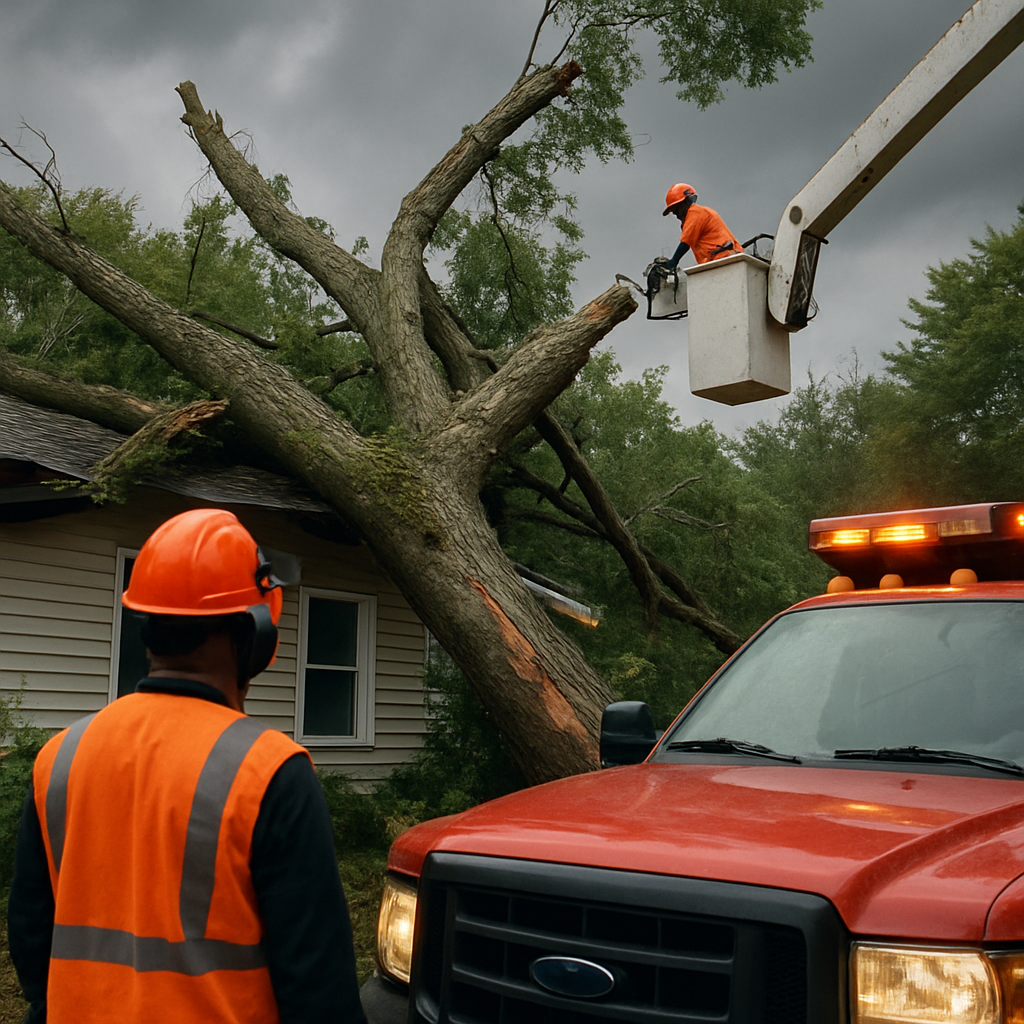
Concrete example: A large oak is leaning toward a house after saturated soil and wind. You should photograph the tree from two angles, call the utility if branches are near lines, rope off the yard, and call local emergency tree services. A typical response is a same day or next morning assessment; crews will assess for root plate failure and rig controlled cuts or crane assistance if the tree threatens the roof.
What people commonly misunderstand: small visible damage on one side of a trunk does not mean the tree is safe. Internal failure or a split under bark can hold until a gust triggers complete collapse. Treat any split, major lean, or exposed root plate as an urgent risk that warrants emergency arborist services.
Do not touch trees on or near power lines and do not attempt to remove hanging limbs yourself. Call 911 for injuries and the utility for electrical hazards before calling a tree cutting service.
2 Deciding when to search for emergency tree service near me
Decide by risk, not emotion. If a tree creates an immediate path to injury or prevents escape, treat it as an emergency and get professional help now — look up emergency tree service near me and call the first insured crew with an emergency dispatch.
Decision matrix: what to call for and how fast
| Condition | What it means | Action / Expected response time |
|---|---|---|
| Tree on or through a building | Structural compromise, roof or wall penetration | Immediate dispatch — same day; tarp and shoring may be needed after controlled removal |
| Tree blocking primary access (driveway, main door) | Egress and emergency vehicle access are cut off | Priority urgent — within 24 hours to restore access |
| Large hanging limb above occupied area | A hanger can drop unpredictably under load | Urgent — same day or 24 hours; do not park or occupy the area beneath |
| Root plate failure or severe lean | Tree is unstable and likely to fall | Immediate to urgent — evaluation and stabilization the same day if possible |
| Tree contacting power lines | Electrical hazard; life-safety issue | Contact utility first; professional crews coordinate with utility for deenergizing before any work |
| Minor branch drop, no lean, no structure threatened | Cosmetic or low-risk damage | Schedule routine tree cutting service — within days to weeks depending on availability |
- Hanger: a partially detached limb that can fall without warning. Action: clear the area, do not touch, and request an urgent assessment.
- Tagged defect: a visible crack, cavity, or split that weakens the trunk. Action: treat as potentially urgent if the defect faces structures or high-traffic areas.
- Root plate failure: the root ball lifts or soil heaves after heavy rain. Action: assume collapse risk and call for immediate stabilization and removal.
Tradeoff to accept: immediate removal often costs more because crews bring specialized rigging, work at short notice, or operate at night. The tradeoff is predictable: higher up-front expense versus a higher probability of secondary damage, insurance complications, or personal injury if you wait. After major storms expect longer waits; insist on written arrival windows and temporary stabilization if a same-day crew is not available.
Concrete example: A pine has fallen onto a garage roof and the soffit is crushed. This is a clear immediate call for emergency arborist services; crews typically secure the structure, cut sections with rigging or a crane, and protect salvageable contents before debris removal. Expect the carrier to document the damage for your insurer and to coordinate with you on a temporary tarp if weather is pending.
Another use case: A large limb is hanging over a parked car. That is urgent but not necessarily a structural emergency. Rope off the area, move vehicles, photograph damage, and schedule same-day or next-day removal. A competent crew will lower the limb in sections to avoid collateral damage.
3 What professional emergency crews do on arrival
Immediate mission: on arrival a professional emergency crew performs a rapid safety triage, secures the site, and creates a controlled plan to remove the hazard with the least additional damage. The crew lead, usually an ISA certified arborist or an experienced foreman, makes a quick risk decision that determines whether they stabilize, remove in sections, or call for heavy equipment such as a crane.
Triage, scene control, and coordination
First actions on site: crews mark a safety perimeter, check for utility involvement, and verify that all occupants and pets are clear. They often place cones, barrier tape, and signage then assign roles – saw team, rigging operator, traffic control, and a documentation lead who records photos for insurance. If power lines are involved they will pause work and coordinate with the utility before any cutting begins.
Practical tradeoff: rapid sectional removal is safer for structures but takes longer and costs more than felling a tree in one shot. A controlled, sectioned approach reduces collateral damage to roofs, patios, and landscaping; the tradeoff is extra labor, rigging hardware, and time on site.
Common tools and why crews choose them
| Equipment | Primary purpose |
|---|---|
| Bucket truck / aerial lift | Provide safe elevated access for saw teams and place rigging points without climbing the tree |
| Rigging lines and block and tackle | Control the direction and descent of heavy sections to protect structures |
| Crane | Lift large trunk sections where access or load control is not feasible with rigging alone |
| Chipper and brush trucks | Reduce debris volume on site and speed removal from the property |
| Chainsaw teams and hand tools | Perform precision cuts and remove smaller limbs once the heavy sections are out |
Typical removal sequence for a house strike: secure the area, place tarps and cribbing over vulnerable surfaces, make preliminary cuts to reduce canopy leverage, rig and lower trunk sections top down, remove debris to a chipper staging area, then inspect and document structural impacts. Crews will often leave a visible tag or written note showing what was removed and any recommended follow up such as stump grinding or structural shoring.
Concrete example: a homeowner calls after a maple split and leaning onto the garage. Mr Tree Inc. dispatches a two truck crew within hours – a bucket truck and a chipper truck. On arrival the crew sets a perimeter, gets utility confirmation, places tarps over the garage, then uses rigging from the bucket to lower 10 foot sections while the chipper team clears. The crew leaves a photo record and a written estimate for full removal and stump grinding.
Judgment most homeowners miss: cranes are not a luxury item in emergency removal – they are a mitigation tool. In tight yards or where a tree pierces a roof a crane often costs more up front but reduces the chance of secondary damage that will delay insurance repairs and increase total cost.
Do not assume quick removal means safe removal. Prioritize crews that show a clear plan for stabilization, controlled lowering, and documentation for insurance.
4 Coordinating with utilities, insurers, and permits
Coordination failures cost time and money. When a tree intersects power, property, or public right of way, the real work is not just cutting wood — it is sequencing the right calls so crews can act legally and safely without creating liability for you.
Utility first, then the saw team. Always notify the utility before any work near service drops or power lines and keep proof of that contact. Utilities will either deenergize, send a line crew to assist, or require a certified crew to work under their supervision. Trying to bypass that step to speed removal is both illegal and dangerous.
Insurance coordination is mitigation plus documentation. Emergency mitigation — tarping, temporary shoring, and sectional limb removal that reduces imminent risk — is typically allowed without prior adjuster approval when life or structure is threatened, but insurers want timestamped photos, a written estimate, and a clear invoice. If you accept an upfront emergency fee, insist on a detailed receipt and scope so the insurer can reimburse properly.
Practical tradeoffs and real limitations
Tradeoff: waiting for a utility crew can delay removal by hours to days after major storms, but forcing action without deenergizing risks electrocution and insurer denial of claims. Limitation: many utilities will not deenergize privately owned secondary services for nonlife-safety work — expect them to prioritize threats to public safety and critical infrastructure first.
Common mistake: homeowners let a contractor promise immediate removal and then pay cash. That removes leverage for documentation and often complicates insurance claims. Use a contractor that provides photo documentation and an itemized emergency invoice; if you search for emergency tree service near me, ask specifically about their insurance-claims workflow.
Concrete example: A large elm fell and is leaning on a house and touching the meter base. You call the utility; they confirm the service must be isolated. The emergency crew waits for the utility to tag the line, then performs sectional rigging to lower the tree, covers the roof with tarps, and supplies a stamped invoice and photo packet for your insurer. Without the utility tag and documentation, your insurer may contest responsibility for structural mitigation.
- Who to contact first and why: Utility company — for any electrical contact or near-contact; they control safety and deenergizing.
- Insurance adjuster: for structural damage claims and to note emergency mitigation; provide photos and the contractor estimate.
- Local permitting or code office: notify when public trees or regulated removals are involved — many jurisdictions allow emergency work with retroactive permits.
Template note to send to utility and your insurer
Use this when you call or email — paste and edit the brackets.
- To: [utility outage number / email]. Subject: Emergency tree contact at [address]. Description: [Tree species/size] leaning on/entangled with [service drop/meter/transformer]. Safety risk: [roof penetration/exposed wires]. Photo attached: [filename]. Please advise on deenergizing or field crew response. Caller: [name, phone].
- To: [insurer claims email/phone]. Subject: Emergency mitigation needed at [address]. Date/time of event: [timestamp]. Damage: [tree on structure, roof penetration, etc.]. Immediate action requested: temporary tarping, sectional removal. Contractor: [company name, license, insurance]. Photos and contractor estimate attached.
Next consideration: if the utility response time is long, request documented temporary stabilization from your emergency contractor and a clear arrival window. That single document reduces disputes and signals to insurers and permit offices that you acted responsibly.
5 Typical cost factors and price ranges for emergency tree work
Straight to the point: emergency tree work costs come from four hard realities — access, size/species, hazard complexity, and time. These are the levers that drive a quote from a modest daylight limb cut to a crane-assisted roof strike removal.
Primary cost drivers: access and logistics (tight yards, fenced properties, or steep slopes add hours and gear); tree size and species (hardwoods and large diameters need more cuts and heavier rigging); hazard complexity (trees touching structures or lines require rigging, tarping, and utility coordination); and timing (night, weekend, or immediate response often includes a 25 to 100 percent surcharge).
How contractors break down a price
- Labor and crew size: more climbers and ground crew equals more hourly cost; complex rigging needs specialized operators.
- Equipment mobilization: bucket trucks, cranes, and chippers each carry travel and hourly rental charges; cranes add a large fixed cost but can cut downstream damage.
- Disposal and stump work: hauling, chipping, and stump grinding are usually separate line items — expect an additional 150 to 900 depending on stump diameter and access.
- Emergency or after-hours fees: quick response and same day tree service come at a premium; insurers sometimes reimburse but check policy language first.
- Permits and traffic control: local permits or lane closures can add fees and delay work, particularly for street trees or commercial sites.
Price ranges — realistic, not guaranteed: small limb removal typically runs 150 to 600; small tree removal 300 to 800; large tree removal commonly 1500 to 5000; crane-assisted complex removals range 3000 to 10000+ depending on crane size, travel, and lift time. Regional labor rates and site complexity make these ranges broad — treat them as planning numbers only.
Three hypothetical emergency estimates (line-item snapshots)
- Low complexity — torn limb over yard (same day): labor and two-person crew 2 hours 250; chip and haul 100; disposal fee 50. Total ~400.
- Medium complexity — small tree on fence and shed (urgent next-day): crew (4 people) 6 hours 900; bucket truck 300; chipper 200; haul/disposal 200; stump grinding optional 250. Total ~1850 (with stump grinding ~2100).
- High complexity — large oak through garage roof, crane required (emergency mobilization): crew and rigging 2000; crane and operator 3500; bucket truck 600; tarping/shoring 400; chip/haul 600; documentation/insurance packet 250. Total ~7450.
Practical tradeoff to accept: hiring the cheapest available crew to get a tree down fast often omits structural protection and documentation. That lowers your immediate outlay but raises the chance of insurance denial or increased repair costs later. Paying for controlled lowering or a crane is insurance against secondary damage in tight or high-risk scenarios.
Real-world limitation: after large storms local crews may apply surge pricing and have multi-day waitlists. If timely removal matters, expect to pay for same day tree cutting service or accept documented temporary stabilization until full removal is possible.
Concrete cost example: a cedar toppled across a private driveway and leaning into a low-voltage line required utility isolation, a two-truck crew, and sectional lowering. The contractor billed a 1200 emergency mitigation fee (crew and utility coordination), 350 for chipping, and 175 for haul — total 1725. The homeowner used the itemized invoice to secure insurer reimbursement for the mitigation portion.
Next consideration: when soliciting bids ask whether the quote includes stump grinding, hauling, permits, and surge fees. Clear scope up front prevents surprise invoices and speeds insurance reimbursement.
6 How to choose the right emergency tree service near me
Straight truth: when you search for emergency tree service near me you are buying risk management, not just a saw and a truck. Prioritize crews that reduce future cost and liability through insurance, documented procedures, and the right gear over the lowest immediate price.
Critical hiring checklist
- Insurance: confirm commercial general liability and workers compensation. Ask for insurer name and policy number and call the insurer if the job is large or involves a structure.
- Qualifications and experience: request an ISA certified arborist or a foreman with documented emergency removal experience; certifications alone are not a substitute for demonstrated storm work.
- Written scope and itemized estimate: get line items for labor, equipment (crane, bucket truck), chipping, haul, tarp/shoring, and any emergency surcharges before work begins.
- Safety and utility coordination: verify they will contact the utility for any wires and that they follow a written on-site safety plan including perimeter control and rigging protocols.
- References and local footprint: prefer crews with recent local reviews or referrals — local vendors are less likely to be fly-by-night storm chasers.
- Payment terms: decline large cash-upfront demands; acceptable deposits are small and documented, with a clear final invoicing process tied to deliverables and photos.
Practical trade-off: small local crews can arrive faster but may lack a crane or heavy rigging; a larger outfit with that equipment may have a 24–48 hour window but will reduce collateral damage. Choose based on the immediate risk to structures and access constraints, not just ETA.
Red flags that mean walk away
- No proof of insurance or refusal to provide insurer contact.
- Pressure to pay full amount in cash before work or refusal to provide a written receipt.
- Vague scope — the contractor cannot list equipment or the sequence they will use.
- Offers to remove a tree on or near power lines without coordinating the utility.
Concrete example: A homeowner with a poplar leaning into a garage received two bids. One small crew offered immediate removal for a low cash price but could not guarantee crane availability or provide insurance proof. A second, insured company quoted higher but included crane mobilization, tarping, and a documented photo packet for insurance. The homeowner chose the documented crew; the crane avoided a secondary roof puncture that would have doubled repair costs.
What to ask on the phone (quick script)
Call script: Hi, my name is [name]. I have a [species, approximate diameter] tree leaning on/near [roof, driveway, power line] at [address]. Are you insured (CGL and workers comp)? Do you have an ISA certified arborist or experienced emergency foreman available? What's your ETA and estimated on-site assessment window? Will you coordinate with the utility and provide a written estimate, photo documentation, and an itemized invoice? What deposit do you require?
If you want a local vendor to verify against this checklist, check Mr Tree Inc. emergency tree services for credentials, response times, and their insurance-claims workflow.
Next consideration: choose the crew that reduces total liability and downstream repair risk, not the cheapest immediate fix.
0 Comments