

Affordable Tree Removal: How to Get a Safe, Fair-Priced Quote Without Sacrificing Quality
Affordable tree removal is possible without cutting corners – you just need to know what a safe, complete quote looks like. This guide breaks down the true cost drivers, a homeowner checklist to prepare for onsite estimates, what an itemized quote should include, and practical vetting steps to spot lowball or unsafe bids. Use these steps to get multiple fair, safety-focused quotes and choose value over the cheapest option.
Why affordable should not mean unsafe
Key point: Affordable tree removal balances price and safety; cut-rate offers usually trade short term savings for long term risk. Low bids commonly omit proper rigging, certified crew members, or sufficient cleanup, and those omissions are where real costs appear after the job is done.
How cheap work becomes expensive
Practical insight: A contractor who reduces labor or skips a lift to save a few hundred dollars increases the probability of property damage, personal injury, and insurance disputes. Cost-efficient tree removal is not the same as cheap tree removal; the former accepts known costs to control risk, the latter often hides risk.
- Hidden cost: property damage – siding, roofing, vehicles, and lawns are at risk when crews use inadequate rigging or inexperienced climbers.
- Hidden cost: liability gaps – a low-price operator who cannot show general liability and workers compensation insurance shifts financial exposure to the homeowner.
- Hidden cost: incomplete scope – stump left, chip hauling extra, or inadequate cleanup which requires a second contractor and extra payment.
Tradeoff to consider: If the tree is small, far from structures, and on flat, open ground, a lower price can be reasonable. For anything near a house, utility line, pool, or tight access, pay for competent crews and proper equipment. That upfront premium usually prevents bigger expenses later and reduces liability risk.
Concrete example: A homeowner accepted a low bid of $350 to remove a 40 foot maple in an urban backyard. The crew worked without a bucket truck and a heavy limb struck a fence and a glass patio door. Repair and replacement costs exceeded $2,000 plus several weeks of dispute with an uninsured crew. A second quote at $1,250 from a certified team included a bucket truck, stump grinding, and proof of insurance and would have avoided the damage.
Judgment: Price signals skill and compliance more often than not. Do not equate low price with value if the bid lacks written scope, an equipment list, or insurance certificates. Conversely, a higher price that lists specific safety steps, permits, and cleanup is frequently the better value.
Major cost drivers and realistic price ranges
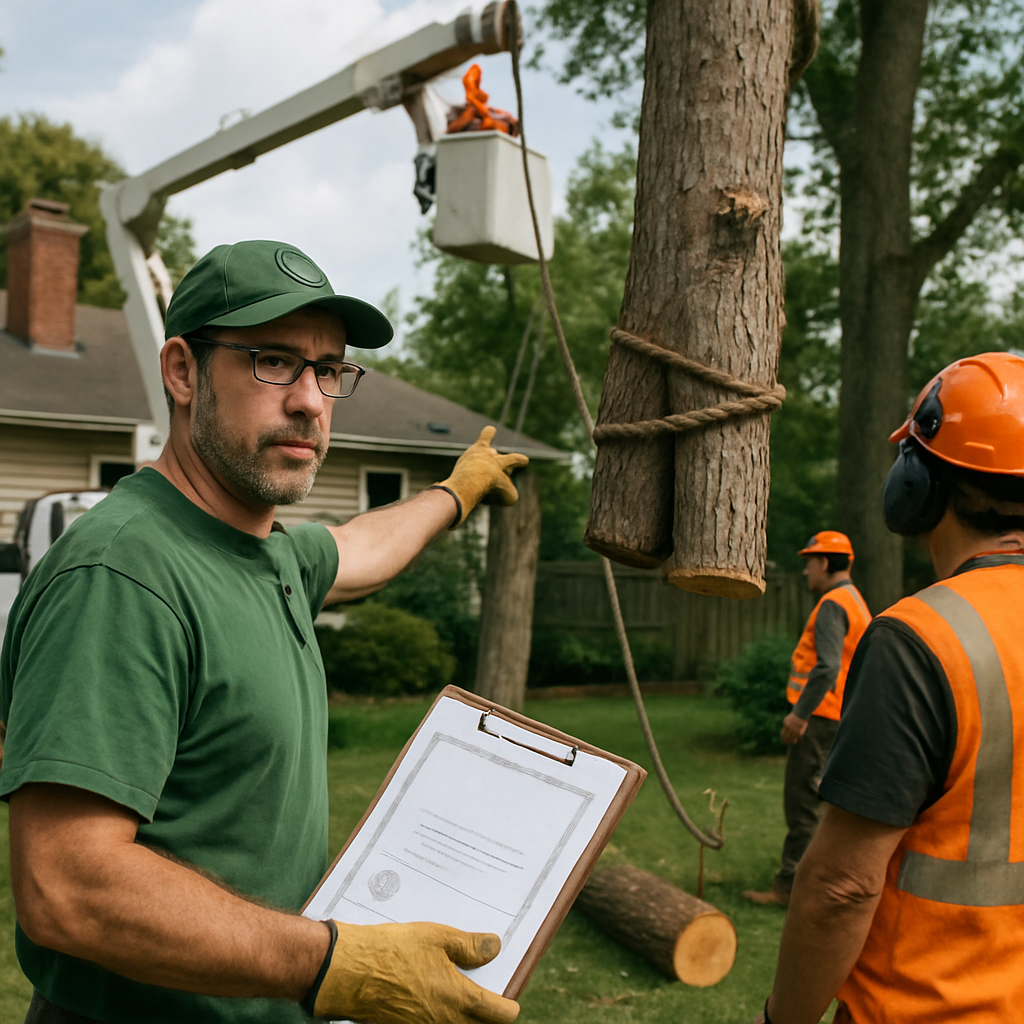
Straight fact: the single biggest cost multiplier is access and risk, not species name. A 40-foot tree in an open field is cheap to remove; the same tree squeezed between a house and a fence becomes a technical removal that can double or triple the price.
How each driver changes the quote
- Access and egress: Narrow gates, steep slopes, or tight alleys force manual lowering, additional labor, or a crane; each adds several hundred to several thousand dollars.
- Proximity to structures or utilities: Work near roofs, cars, pools, or power lines increases rigging time and liability and usually requires more experienced crews and permit work.
- Tree size and wood density: Cost scales with trunk diameter and wood hardness; a dense hardwood with the same height as a softwood requires more time, more secure rigging, and often higher disposal fees.
- Tree condition: Dead, rotten, or wind-damaged trees behave unpredictably; expect contingency charges and safety premiums for unstable removals.
- Equipment needs: Bucket trucks, cranes, winches, and stump grinders are charged into the job. Renting a crane for a tricky lift can add a four-figure line item.
- Debris handling and disposal: Chipping on-site as mulch lowers hauling costs. Tipping fees or long transport increases the final bill.
- Permits and coordination: Municipal permits, utility locates, and HOA approvals take time; some companies include these in the quote, others bill separately.
- Timing and seasonality: Emergency or weekend work carries premiums. Off-season scheduling can be negotiated for a lower rate.
Realistic price bands (typical ranges)
| Scenario | Typical removal range | Common additional costs |
|---|---|---|
| Small ornamental (under 30 ft, clear site) | $150 – $600 | Chip-on-site or $75 – $200 hauling |
| Medium tree (30 – 60 ft, residential yard) | $400 – $1,500 | Stump grinding $75 – $400; permit $50 – $300 |
| Large or restricted (over 60 ft or near structures) | $1,000 – $4,000+ | Crane rental $1,000 – $5,000; specialized rigging fees |
| Emergency removal (storm damage, urgent hazard) | Premium 25% – 100% above normal | After-hours, expedited equipment, overtime labor |
Concrete example: A homeowner needs an oak removed from a narrow side yard. A crew able to do the job with standard rigging quoted $1,200. A second contractor recommended a crane because of a low roofline and quoted $3,800. The crane option cost more but eliminated the risk of roof damage and shortened the job to one day.
Practical tradeoff: paying for the right equipment is usually cheaper than repairing damage after a rushed removal. If cost is the limiting factor, negotiate on scheduling (off-peak timing), accept chipping instead of hauled debris, or ask for a reduced scope such as sectional removal rather than full-site cleanup.
Key takeaway: affordable tree removal comes from matching the correct method to the risk profile, not from forcing cheaper methods onto high-risk jobs.
How to prepare your property so estimates are accurate
Start with useful information, not excuses. Contractors give tighter, more reliable bids when you supply clear photos, measurements, and access details ahead of the visit. Vague, last-minute information forces estimators to add large contingencies to cover unknowns — and those contingencies show up as higher quotes.
What to document before a contractor arrives
- Take a short video walk-around. Walk slowly around the tree while narrating obstacles (pool, playset, fence) so the estimator hears what you see.
- Photograph access points. Gate widths, driveway turn radiuses, and fence clearances matter more than tree species for equipment choice.
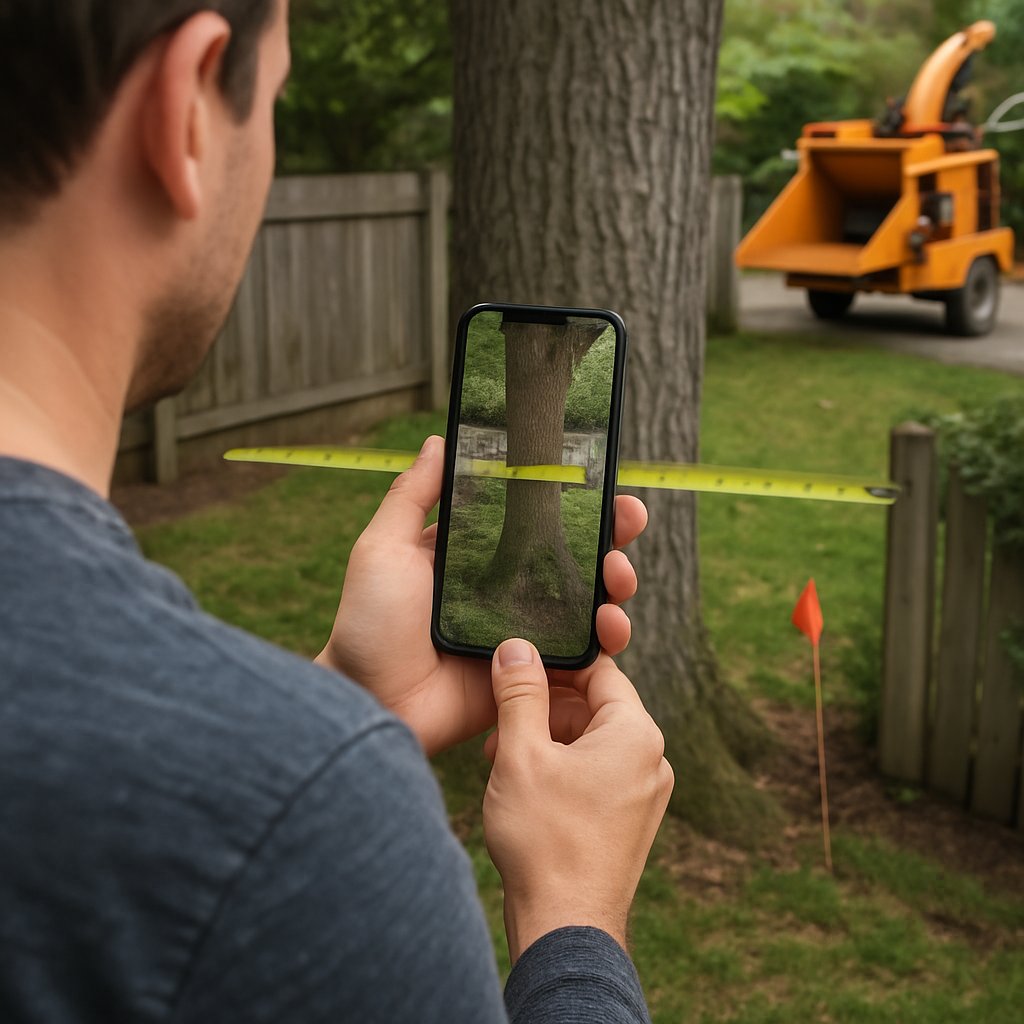
- Measure or estimate trunk diameter and height. Use a tape if you have one; otherwise measure trunk circumference at knee height and divide by 3.14 to get diameter — include your method in the message.
- Mark hazards visibly. Use flags or bright tape for utility lines, septic covers, invisible fences, or sprinkler heads so crews can confirm them on arrival.
- List disposal preferences. Say whether you want wood hauled away, chipped as mulch on-site, or left in logs for firewood — disposal choices change labor and hauling lines in the quote.
Practical trade-off: Clearing loose debris, lawn furniture, or a car from the drop zone cuts time on the day of work and can reduce the bid. Do not attempt any limb work yourself — removing small items is fine, but cutting limbs creates liability and hides the tree condition the estimator needs to see.
Flag hidden risks early. If the tree is close to a buried septic tank, irrigation lines, or a poorly mapped gas line, tell the estimator up front and share any utility locate receipts. Contractors price around unknown underground utilities; revealing them up front avoids surprise change orders.
Video-first estimates save time but don’t replace onsite checks. A clear video can produce a preliminary, lower-variance quote and weed out obviously unsuitable contractors. Still require an onsite final estimate for jobs near structures or lines — responsible crews will confirm measurements and conditions before starting.
Concrete example: A homeowner sent three 45-second clips showing a 35-foot maple tucked behind a narrow side gate, the gate width, and a photo of the roofline. One contractor declined without seeing the site and another asked for a $150 site fee; a third reduced labor contingency after seeing the clips and offered a firm, itemized quote that was $400 lower than the site-fee bid. The gate access detail eliminated a guessed crane rental from the high bid.
Clear, labeled photos and a short video reduce estimator uncertainty — and that uncertainty is the single biggest reason initial quotes balloon when crews arrive.
What a fair, detailed quote should include
Start with clarity. A fair quote breaks the job into understandable parts so you can compare apples to apples and spot when a low-price bid is hiding costs or cutting corners. For affordable tree removal that actually protects your property, insist on itemized entries, unit rates for changes, and clear responsibility for permits and insurance.
Essential line items and what each one means
| Line item | What it covers | How it is priced – example entry |
|---|---|---|
| Labor | Crew size, hours, and supervision; who is the competent person or certified arborist on site | 3-person crew x 5 hours at $85/hr = $1,275 |
| Equipment | Specific machines required – bucket truck, crane, winch, chipper, stump grinder – and rental or day rates | Bucket truck day rate $375; chipper $95/day |
| Method and rigging | Describes removal method – sectional lowering, crane-assisted lift, or ground-based drops – and any special rigging materials | Sectional lowering with block and tackle; rigging kit charge $140 |
| Stump grinding | Depth, number of stumps, and unit pricing by diameter or flat fee; note disposal of grindings | Stump grind 12 inch diameter – flat $180 (includes chip-on-site) |
| Debris handling and disposal | On-site chipping vs hauled loads; tipping fees or haul distance if applicable | Chip-on-site included; hauling full truckload to landfill $130 |
| Permits and utility coordination | Which permits are required, who pulls them, and if utility locates are included | Permit handling fee $95; utility locates paid by owner unless included |
| Cleanup and final inspection | Define what clean looks like and whether the contractor will sweep, rake, and remove nails or metal | Site broom sweep and rake included; final walkthrough by foreman |
| Insurance and proof | Statement that contractor will provide certificate of general liability and workers compensation before work | COI to be emailed 72 hours before start |
| Timeline, payment terms, and warranties | Start date window, progress payments, final payment holdback, and limited workmanship warranty | Start within 10 business days; 30 percent deposit, remainder on completion; 30-day workmanship warranty |
| Change order rules | How unforeseen conditions are handled – unit rates and approval process for additional work | All extras require written change order; labor $85/hr per tech; crane $250/hr |
Practical tradeoff. A binding, all-in quote reduces surprise costs but usually comes with a higher upfront price because the contractor absorbs risk. An estimate that lists unit rates and requires signed change orders keeps the base quote lower but requires you to accept that hidden conditions – rot, internal failures, or buried fixtures – will add cost at published rates.
Concrete example: A homeowner received a written estimate that included a 3-person crew, bucket truck, stump grinding at a flat fee, and explicit disposal terms. During the job the crew found internal decay requiring extra rigging. Because the contract specified unit rates and a required written change order, the homeowner approved the additional rigging charge and the final invoice matched the quoted structure without surprise fees.
- Ask at the estimate: Who will supervise the job and are they an ISA certified arborist or equivalent
- Request before signing: An emailed certificate of insurance naming you as certificate holder if requested and a copy of any required permits
- Require in writing: Change order approval process, hourly rates, and a clear finish criteria for cleanup

A clear, line-item quote with unit rates and a signed change-order process is the single most effective tool for getting safe, cost-efficient work without later disputes.
How to vet companies and verify credentials
Start from documents, not promises. Verbal assurances about experience or coverage are common; treat them as provisional until you see and verify paperwork. The two documents that decide whether a bid is safe are a current certificate of insurance and an on record certification for the supervising arborist.
Six practical verification steps to run before you sign
- Obtain a Certificate of Insurance and verify it. Ask for a COI that lists general liability and workers compensation. Recommended baseline is at least $1,000,000 liability. Call the insurer using the phone number on the carrier website not the number on the COI and confirm policy number, effective dates, and that subcontractors are covered.
- Confirm the supervising arborist. Request the name and certification number for the ISA certified arborist or equivalent who will supervise the job and check them via treesaregood or the ISA directory. If the quote names only a crew foreman with no certification, probe for relevant supervision experience.
- Match licenses to local requirements. Ask for the company business license number and check it on your city or county licensing portal. If permits are required for removal in your jurisdiction the estimator should either include permit pulling in the scope or show a process for how permits will be handled.
- Request recent, similar-job references with contactable details. Get at least three jobs done in the last 12 months similar in access and tree size to yours. Ask for the name, phone, and address and follow up. Photos without client contacts are easy to fake.
- Confirm equipment and subcontractor coverage. Get a written list of the major equipment to be used and any subcontractors. If a subcontractor will perform any work, that subcontractor must appear on the COI or you assume risk.
- Watch payment and contract terms for danger signs. Avoid cash-only offers, upfront deposits greater than 30 percent for routine jobs, or contractors who refuse a written scope and change-order process. Require a written contract that includes unit rates for extras.
Quick scripts that work. Use short, direct wording when you ask for documents. Example for COI request: Please email the current COI showing policy numbers and effective dates for general liability and workers compensation. I will verify with the carrier before the start date. For an arborist verification ask: Who will supervise the job and what is their ISA certification number, so I can confirm it on the ISA directory.
Tradeoff to accept. Expect verification to cost time and sometimes delay scheduling. That is the tradeoff for avoiding major liability or property damage. For simple, low-risk jobs you can be pragmatic about timelines. For jobs near structures, utilities, or public right of way, hold fast on full verification.
Concrete example: A homeowner accepted a bid only after calling the insurer listed on the COI and discovering the policy had lapsed five days earlier. The contractor produced an updated COI and arranged a verified start date. Another crew that refused to produce a COI and asked for a cash deposit was declined and later found in local complaints on the Better Business Bureau.
Key step: call the insurer directly and confirm policy details. Documents without verification are window dressing.
If you want one reliable reference point on standards and safety practices see TCIA and for arborist certification verification visit treesaregood. Verifying credentials is not bureaucratic nicety. It is the single most effective way to keep affordable tree removal from becoming an expensive problem.
Ways to lower costs without compromising safety
Direct point: You can reduce the bill for affordable tree removal without stripping out required safety steps, but the savings come from changing the job scope and logistics, not from asking crews to skip rigging or insurance.
Practical, safety-first tactics that actually move the price
Offer practical site prep: Clear the drop zone of cars, furniture, and garden items and create a staging spot for equipment. Crews charge less when they do not spend time moving obstacles or ferrying tools through tight gates. This is inexpensive work you can do that materially lowers labor hours.
Be flexible on timing: Accept a wider start-window or schedule for the contractor off-peak. Labor and equipment availability change seasonally; agreeing to a midweek or off-season date often reduces the day rate without affecting which safety gear the crew uses.
Trade disposal for a price cut: Let crews leave woody material on site as mulch or split logs into firewood. Removing haul-away and tipping fees is a legitimate way to lower cost; be explicit about what remains so you do not end up with a surprise cleanup charge later.
Ask for scope options, not shortcuts: Request tiered quotes that show a safe baseline and optional add-ons (stump grind, crane, extended cleanup). Comparing unit-priced options lets you pick the safest minimal approach rather than pushing a crew to eliminate required safeguards.
Leverage small batch discounts: If you have several trees or neighbors needing work, ask for a bundled price. Contractors will often reduce mobilization costs per tree when multiple jobs are scheduled in the same area. This keeps full safety procedures while lowering per-tree cost.
Get a targeted risk assessment instead of immediate removal: For borderline cases, pay a certified inspector to evaluate the tree and propose a focused mitigation plan — pruning, cabling, or selective limb removal may be vastly cheaper than full felling while preserving safety. Use arborist services for a documented opinion you can show bidders.
Negotiate written, conditional discounts: Ask for a small discount if you provide access, accept on-site chipping, or allow minimal staging on your driveway. Insist these concessions are written into the itemized quote so safety steps and unit rates remain unchanged.
Tradeoff to note: Savings that remove supervision, certified personnel, or rigging are false economies. Reductions should come from logistics and scope choices you control — not from persuading the crew to take on more risk. In practice, vendors will give modest, predictable discounts for homeowner-prep and scheduling flexibility but will not and should not cut insurance or certified supervision.
Concrete example: A homeowner negotiated a $350 reduction by agreeing to keep the driveway available for the chipper and splitting the resulting firewood for the crew. The contractor kept the same certified foreman and equipment; the only change was lower hauling time. The job still included stump grinding and a verified COI.
Step-by-step homeowner checklist for getting and comparing quotes
Straight to the point: if you want affordable tree removal that is safe, treat quote collection like a small procurement project. The checklist below forces comparability, reduces surprise add-ons, and gives you leverage without sacrificing required safety measures.
Before you contact contractors
- Document the site: shoot 4–6 labeled images (trunk close-up, canopy, drop zone, access routes) and a 30–60 second walk-through video. Upload them with your inquiry so bidders work from the same facts.
- Record key measurements: note approximate tree height and trunk diameter and write down gate widths and driveway constraints. If you cannot measure, estimate and mark your method so each contractor uses the same baseline.
- Note fixed hazards: list overhead wires, nearby structures, pools, septic covers, and any visible decay. If you suspect buried utilities, get a locate before bids if possible.
- Decide disposal preference: choose chip-on-site, haul-away, or leave logs for firewood and include that in your request so pricing lines match across bids.
- Gather local rules: check or note any municipal tree-removal permits or HOA restrictions to tell estimators up front; some crews include permit handling as an option.
At the onsite estimate — what to do and ask
- Walk the estimator through the job: show the same hazards and access points you documented; watch how they answer and whether they point out additional risks.
- Get names and proof on the spot: request the supervising person’s name and certification number, and ask to view a current COI on their phone. If they hesitate, mark that as a concern.
- Ask for an itemized approach: have them explain removal method (sectional lowering, crane, lift), equipment planned, and an explicit stump option. If the estimator gives only a vague lump-sum, ask for line items.
- Clarify timing and contingencies: request a start window, expected crew size, and a short list of things that would trigger a change order and how those will be priced.
- Use short scripts: say I will compare three written quotes; please email a one-page itemized estimate within 48 hours — this sets expectation and timeline.
After you receive quotes — a practical comparison method
Practical insight: price alone lies. Use a simple scoring rubric to make apples-to-apples choices — safety and scope should outweigh tiny dollar differences for moderate- and high-risk jobs.
- Normalize scope: first, ensure each quote covers the same disposal and stump option. If not, ask for adjusted line items so you compare identical scopes.
- Score three dimensions: Safety (insurance, certified supervisor, described rigging) = 0–5, Scope completeness (itemized lines, cleanup, permits) = 0–5, Price competitiveness = 0–5. Tally and prefer higher safety/scope, then price.
- Probe anomalies: whenever a bid is much lower, ask the estimator to walk you through what they excluded. If they cannot provide written exclusions, treat the quote as unreliable.
- Confirm COI and license before signing: call the insurer using the carrier’s published number to confirm coverage and effective dates. Require an emailed COI and any permit paperwork 72 hours before start.
Tradeoff to accept: choosing the lowest score on safety to save a few hundred dollars trades predictable outcomes for uncertainty. For tight-access or near-structure work, prefer the higher-scoring bid even if its price is 20–30 percent above the cheapest offer.
Concrete example: a homeowner collected three bids for a 45-foot tree. The cheapest omitted stump grinding and listed only a 2-person crew; the mid-price bid included a bucket truck and a named ISA-certified supervisor; the highest bid added crane time. Using the 0–5 rubric the homeowner selected the mid-price option because it balanced documented safety measures and a complete cleanup scope — final cost was within budget and without surprises.
If a contractor resists an onsite check for a job near structures, do not accept their remote-only price; onsite verification is where real risks get priced.
0 Comments