


How to Choose the Right Tree Trimming Service Near You: Questions to Ask Before You Call
If you typed tree trimming service near me into a search bar, you already have half the battle, but finding the right company is the harder part. This short guide gives a pre-call checklist, 12 specific questions to ask, how to verify licenses and insurance, tips for comparing written estimates, and the red flags to watch for. Use it to call two or three local contractors with confidence and get safe, professional tree care without the guesswork.
Prepare Before You Call: What to Gather and Why
Start with clear facts, not guesses. Before you dial a tree trimming service near me, collect the data that directly changes how a crew will work: current photos, the tree location relative to structures and utilities, access constraints, and what outcome you want (trim, prune, or remove). These items determine equipment, crew size, permit needs, and whether the contractor can give a realistic ballpark over the phone.
Photos and measurements that actually help
A few well-composed photos beat vague descriptions. Take shots from both sides of the tree, one from the base showing trunk diameter, one from the street showing clearance to the roof and power lines, and a short video of any lean or visible rot. If you can, include a person or a tape measure in one photo for scale. Smartphone height-estimate apps can help but are not a substitute for visuals that show access and obstacles.
- Address and tree location: note if the tree is in the yard, on the property line, or in the public right of way
- Three photos + one short video: base, overall from street, canopy-to-structure, and a video showing lean or damaged limbs
- Access notes: gate width, driveway slope, overhead wires, nearby parked cars, and whether large equipment can be staged
- Approximate size: trunk diameter at chest height (or measure circumference) and rough height if you can estimate it
- Desired outcome: crown reduction, selective pruning, stump grinding, or full removal; whether you want wood hauled or chipped on-site
- Timing and urgency: seasonal preference or emergency status and whether neighbor approval is needed
- Utility check reminder: plan to call Call 811 or ask the contractor to confirm underground utility markings
Trade-off to accept: more and better photos will often remove the need for an immediate site visit, but not for complex or high-risk jobs. If a tree overhangs a house or sits beside power lines, expect an on-site inspection before a firm quote. Contractors quote risk and access first; missing details lead to vague bids or high contingency fees.
Concrete Example: A homeowner with a mature oak behind a narrow side gate saved time by photographing the gate width and driveway slope. The contractor saw the access limit and quoted a climbing crew instead of a crane, lowering the mobilization fee and giving an accurate bonded estimate. Without those photos the first visit would have been a discovery trip and delayed scheduling by a week.
If you can only do one thing before calling, send three photos (base, canopy versus house, and access point) and state whether you want wood kept or removed.
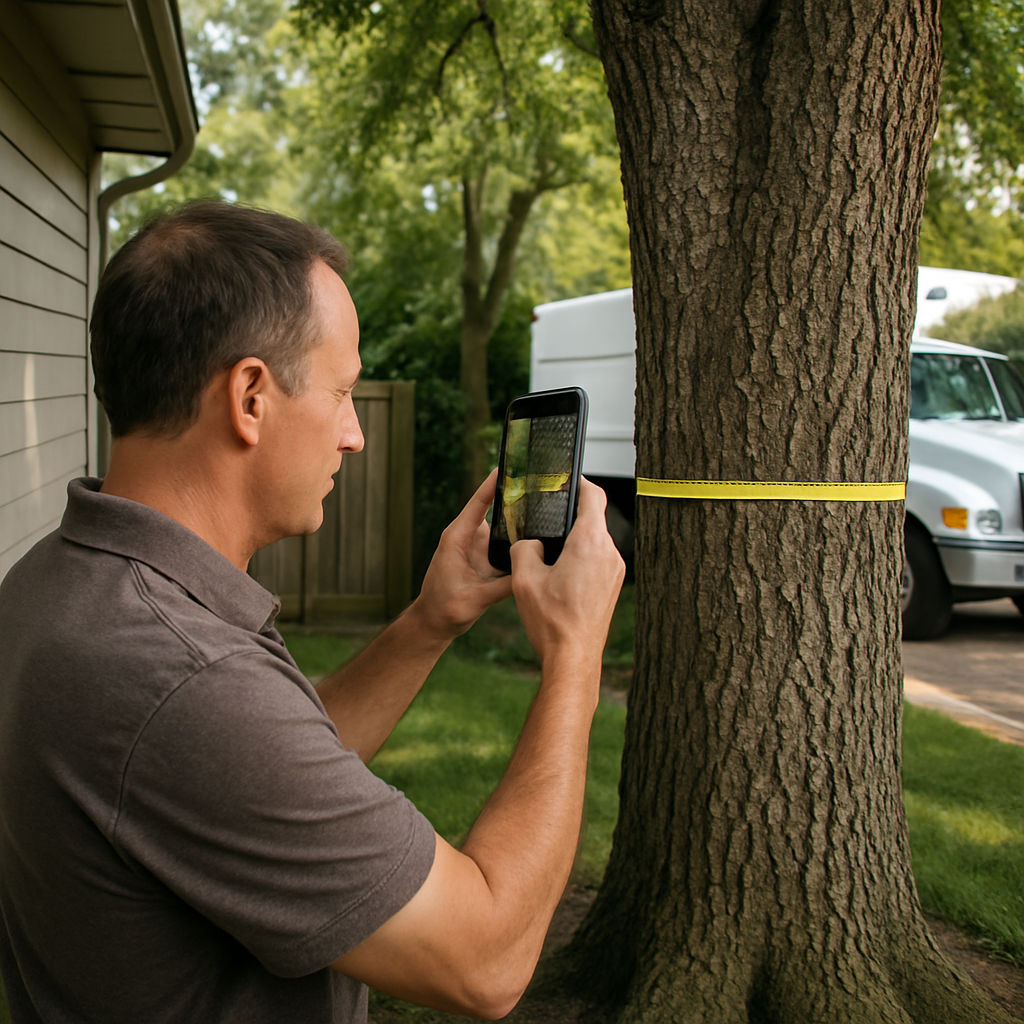
Next consideration: After you gather these items, send them to two or three local companies (including a search for tree trimming service near me) and ask for a written ballpark before scheduling an on-site inspection. That one step weeds out contractors who quote blind and saves you time.
12 Essential Questions to Ask a Tree Trimming Service
Start with specifics, not promises. Use these 12 questions on your first call or during the site visit to force clear answers — the companies that stumble are usually the ones you should cross off the list.
The 12 questions (and what good answers sound like)
- Are you licensed and insured and can you send a
COInow? A good answer includes general liability (commonly $1M+), workers compensation, and a phone number to verify the policy. - Do you employ a certified arborist or have arborist oversight? Accept on-staff ISA certificants or clear subcontracting to a named arborist with a certification number you can verify.
- Can you share three recent local references or project photos? Ask about jobs similar in size and access; a reliable company will supply names and phone numbers.
- Will I receive a detailed written estimate and contract? The estimate should list per-tree work, disposal, timeline, and payment terms — not a one-line total.
- Which pruning standards do you follow? Look for ANSI A300 / ISA best practices and intolerance of topping or flush cuts; vague answers are a red flag.
- Who will do the work and what equipment will you use? Request crew size, lift versus climbing, and whether traffic control will be used for street-side work.
- Who handles permits and utility coordination? Expect the contractor to coordinate with the power company and either call 811 themselves or require you to do it; they should know local permit triggers.
- What is your cleanup and disposal policy? Confirm chipping versus hauling, whether mulch is left onsite, and how large wood is handled — price differs significantly by option.
- How do you protect the property and manage accidental damage? Ask about ground protection, cribbing, and a written damage remedy policy backed by insurance.
- What are your payment terms, deposit amount, and change-order process? Reasonable deposits are 10-30 percent; avoid full payment upfront and require written change orders.
- Do you offer emergency response, and how is it prioritized and priced? Get a stated response window and whether emergency calls carry a surcharge.
- Do you provide post-service follow-up, a warranty, or written tree-care recommendations? Expect a short follow-up inspection and a written list of health recommendations for valuable trees.
Practical trade-off: Accept that faster response or complex equipment (cranes, lifts) raises cost. The right answer is not the cheapest one but the one that explains why a price is higher and ties that reason to safety or reduced risk to your property.
Concrete Example: A property manager with a large maple near a utility line asked about permits and utility coordination. One contractor said they would handle the power company and provide traffic control, another insisted the city would handle permits. The manager chose the first company because they took responsibility for coordination — the city timeline would have delayed the work by weeks and increased interim risk.
Common misconception: Many homeowners treat tree services like commodity labor and shop purely on price. In practice, the difference between crews is safety processes, licensure, and willingness to document scope. If a company dodges any of these 12 questions, it usually means hidden costs or shortcuts.
When you call a company after searching tree trimming service near me, work through these 12 in the first 10 minutes. If a provider can’t give clear, verifiable answers to at least three critical items — insurance, written scope, and safety plan — move to the next bidder or ask for references you can call.
If you want a reference for standards and pruning guidance, see TreesAreGood and for local service comparisons use your notes and photos when contacting a nearby provider such as tree trimming and pruning.
How to Evaluate Answers and Verify Claims
Treat answers as verifiable facts, not promises. When a contractor tells you they are insured, have an arborist, or will handle permits, assume you will need to confirm it before any work starts. Verbal assurances are common; undocumented ones are where homeowners assume risk.
Three practical verification steps
- Document the claim: Ask for the specific document (COI, arborist name and cert number, permit number, or a sample written estimate) and get it by email before scheduling.
- Call the source: Phone the insurance carrier and the municipal licensing office to confirm policy numbers, effective dates, and whether a business license or permit is required for your job.
- Confirm consistency: Match names and numbers across documents — the business named on the COI should be the contractor on the estimate, and the arborist listed should appear in the ISA directory or on their employer roster.
Trade-off to accept: Speed versus certainty. Contractors who insist they must start immediately without producing basic documentation are usually pricing risk into the job. If time is critical because of storm damage, budget a higher premium for verified emergency response rather than skipping verification.
| Common claim | How to verify quickly | What a dodge looks like |
|---|---|---|
| Insured (general liability / workers comp) | Request a certificate of insurance, call the insurer using the number on their site, confirm limits and effective dates. | Sends a photo of a generic COI with different business name or refuses insurer contact. |
| Certified arborist on staff | Ask for the arborist name and ISA number then check at TreesAreGood or ISA directory. | Mentions arborist oversight but cannot supply a name or registration number. |
| Written scope and price | Require an itemized estimate emailed within 48–72 hours; ensure pruning types and disposal are listed. | Provides only a verbal total or a one-line invoice with no line items. |
| Emergency availability | Get a stated response window and written terms for emergency surcharge and priority. | Promises next-day service but gives no booking calendar or surge pricing details. |
Concrete Example: A homeowner received a COI as a PDF and scheduled a removal. Before work, they called the insurer and discovered the policy had lapsed two weeks earlier. The contractor corrected the paperwork but lost the job; the homeowner hired a different company that provided real-time insurer verification and scheduled within the same week. That step avoided a potential liability gap and last-minute cancellations.
Judgment you won't get from a sales rep: Membership badges and nice brochures are noise unless paired with records you can check. In practice, the companies that win repeat local work accept verification up front because it prevents disputes — if a contractor resists simple checks, treat that as an operational risk.
If a contractor won't allow you to verify insurance, permits, or the named arborist before work, consider them a no-go for your property.

Comparing Written Estimates: What to Look For
A written estimate is the single place you turn guesswork into a decision. When bids arrive as one-line totals or vague descriptions, the lowest number usually hides omissions: missing disposal, permits, traffic control, or contingency for hidden decay. Insist on documents that let you compare specific tasks, not salesperson charm.
Turn reports into apples-to-apples comparisons
Start by creating a short comparison template you append to each bid: list each tree by location, the pruning method requested, whether stump work is included, who hauls debris, permit responsibilities, and the estimated start/completion window. Normalize any hourly or mobilization fees into a projected all-in price for the same scope so you can compare totals fairly.
- Scope clarity: a named tree and a described action (for example,
rear-cedar: selective crown reduction 15 percent), not generic trimming. - Equipment and logistics: who provides cranes/lifts, any staged street closures, and whether the crew will need special access or ground protection.
- Disposal and value recovery: chipping and hauling included, mulch left on-site, or firewood stacked for pickup; each option changes cost materially.
- Allowances and contingencies: a stated contingency or allowance for hidden rot or tight access with a clear trigger for extra charges.
- Change-order process: how extras are documented and priced before additional work begins.
Practical trade-off: the most detailed estimate usually costs you less in surprises but may look higher on paper. Transparency raises the visible price because contractors add explicit line items instead of burying them. That extra clarity is worth the premium in most cases.
Concrete Example: You get three bids for a backyard elm. Bid A is the cheapest but lists only a one-line total and says stump grinding is extra. Bid B includes per-tree pruning descriptions, calls out a crane mobilization fee, and specifies chipping included. Bid C charges hourly and lists a 10 percent contingency. Converting B and C to all-in totals shows B is mid-range but includes crane and cleanup; C could exceed both if access causes delays. The homeowner chose B because the scope and disposal were explicit and the contractor accepted permit coordination.
A common blind spot is allowances labeled vaguely as miscellaneous or unforeseen. Ask for the conditions that trigger them and a ceiling where possible. If a contractor refuses to estimate a likely maximum for hidden conditions, treat that as deferred risk you will probably pay later.
Ask for annotated photos or a simple site sketch attached to the estimate. That ties the written price to observable conditions and prevents later disputes about what was included.
Safety, Permits, and Utility Coordination
Safety planning drives cost and legal exposure. Before you hire a tree trimming service near me, insist that the contractor explain how they will isolate hazards, protect bystanders, and coordinate with utilities. Safety is not a checklist item to gloss over; it determines crew size, equipment, permits, and daily staging logistics.
Who must be involved and why it matters
Qualified crews matter for work near power or public ways. If a job touches overhead electrical lines, a regular pruning crew is often not enough. Ask whether the contractor uses a utility-approved line clearance crew or partners with the local power company for de-energizing and grounding. If they claim they can work next to live conductors without utility coordination, treat that answer as a red flag.
Permits add time and accountability. Municipal permits commonly apply when work affects the public right of way, street trees, or protected specimens. Having the contractor handle permit applications reduces homeowner work, but it also adds processing time and fees. If time is the priority, expect to pay for expedited handling or accept a higher emergency premium.
- Confirm these specific items: ask for recent permit numbers or a copy of a permit application they submitted for a similar project
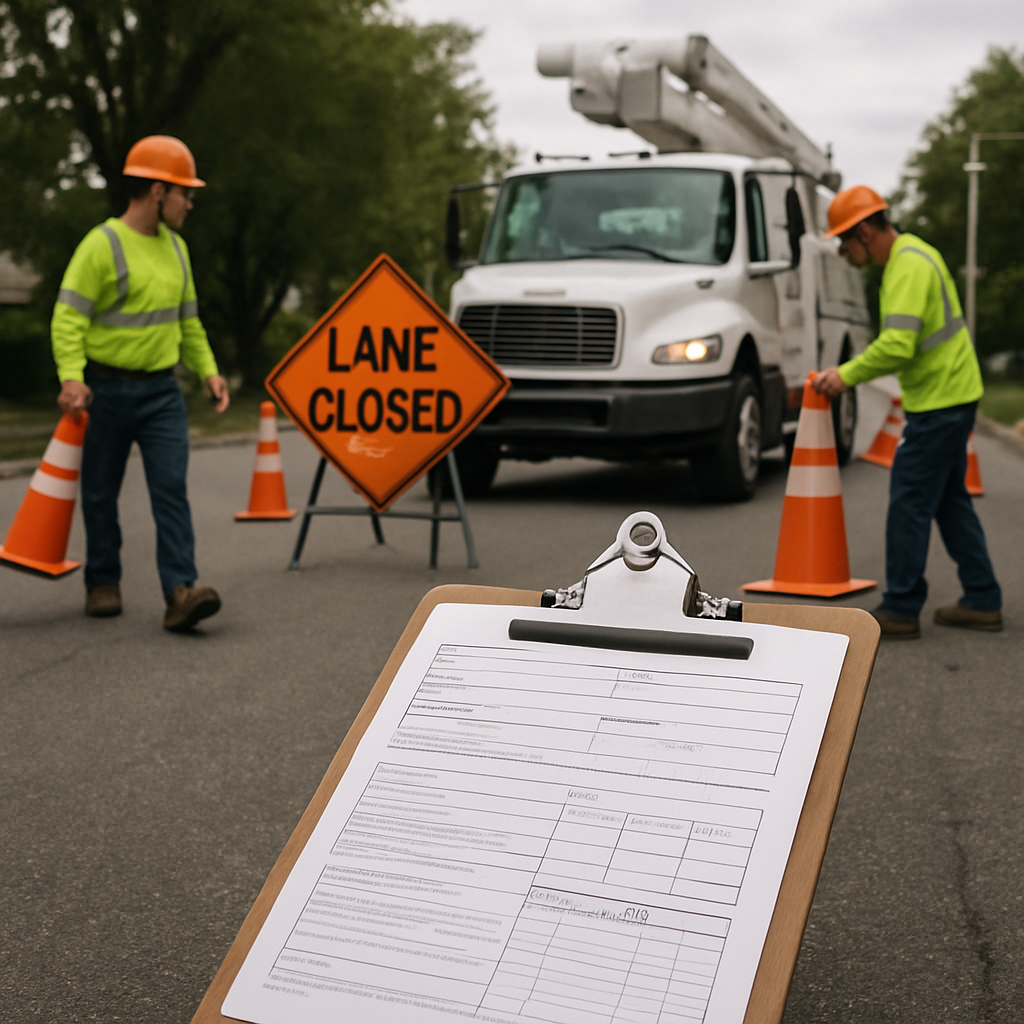
- Traffic and lane control: request proof the crew can provide traffic control plans and licensed flaggers when work requires street or sidewalk closures
- Heavy equipment endorsement: verify the COI has crane or lift endorsements if the job needs a crane or extended aerial-lift operations
- Utility locates: require the contractor to document 811 locates and any coordination with the power company for overhead work
Practical trade off. Letting the contractor own permits and utility coordination reduces your administrative burden and keeps scheduling tight, but it concentrates risk with the contractor. If you accept a lower price because you will handle permit pickup or 811 scheduling, record that responsibility in writing to avoid finger pointing later.
Real-world example: A homeowner had a walnut leaning toward their driveway under a low voltage line. The chosen contractor scheduled a utility company crew to de-energize the span and provided a signed traffic control plan. The job took two extra days but avoided an emergency outage and allowed the crew to use a lift safely. Neighbors reported no service interruption and the job closed on budget.
Common misunderstanding corrected. Many people assume calling 811 resolves all underground and overhead risks. 811 only locates marked buried lines and does not clear live overhead conductors. For work near power lines the contractor must show they coordinate with the utility and can produce contact records or a service order number.
Next consideration. When you call local providers including an arborist near me, make utility coordination and permit handling nonnegotiable line items in your written estimate. If a contractor cannot or will not document how they will protect the public and manage utilities, do not hire them.
After the Job: Inspection, Cleanup, and Follow Up
Don’t assume a finished job is an acceptable job. Walk the site with the crew before anyone packs up and get a signed acknowledgement that the scope was completed as written.
Immediate inspection steps
- Walk the perimeter: Confirm every tree and shrub in the estimate was addressed and that no unintended branches were cut.
- Check cut quality: Look for cuts made at the natural branch junction, smooth saw work, and minimal tearing to bark. Note any large wounds or areas where too much live canopy was removed.
- Scan property surfaces: Inspect roofs, gutters, fences, driveways, and lawn for gouges, torn sod, chip pile damage, or oil/chemical spills from equipment.
- Verify debris handling: Confirm whether chips were left as mulch, hauled away, or stacked for firewood per your contract and that access points and drains are clear.
- Sign-off and photos: Take dated photos of each tree and the staging area, and ask the crew foreman to sign the completion line on the invoice or checklist.
Practical trade-off: Pressing for an immediate, thorough walkthrough costs you a few extra minutes but saves days of hassle. If you delay the inspection, seasonal leaf drop and rain will obscure evidence of poor cuts or accidental damage, and contractors will be able to claim normal settling.
Concrete Example: A homeowner accepted a finished job without a walkthrough. Two days later heavy wind brought down a weakened limb that the crew had left with a ragged end; photos taken at the time would have proven the cut was improper and forced the contractor to return and fix it. With a signed completion form and timestamped images the homeowner resolved the issue within 48 hours and avoided a dispute over responsibility.
Judgment most people miss: Companies that include a written short-term follow-up (for example, a seven- to fourteen-day inspection) demonstrate operational discipline. If a contractor refuses to document a brief follow-up or any corrective terms, it often indicates their quality control is lax and that post-job fixes will be slow or billed as new work.
After the walkthrough, insist on written closure: an updated invoice or completion note that lists what was done, any remaining items, and an agreed timeline for fixes. Keep those records with your contract and photos in case of later issues or insurance claims. If the work touched public property or required permits, request copies of final permit sign-offs or disposal receipts.
Next consideration: Schedule a short follow-up inspection for valuable trees at 3–6 months to catch issues like dieback, pest activity, or poor wound closure. That scheduled check is a small investment that separates contractors who care about tree health from those focused only on the cut-and-go job.
Sample Phone Script and Printable Checklist for Your Call
Get the essentials first. Before you start, have your three photos and the property address ready to send; that turns a vague conversation into a usable quote and often keeps the first call under five minutes.
Phone script (read or adapt)
- Intro: Hi, my name is [Your Name]. I searched tree trimming service near me and need a quote for work at [address].
- Scope in one line: I have [number and species if known] that need [trim / crown reduction / removal / stump grinding]; I can send three photos now.
- Access and hazards: The yard has a [narrow gate / steep driveway / proximity to power lines]; will that change your crew or equipment?
- Insurance and proof: Can you email your
COIshowing general liability and workers compensation before scheduling? - Estimate timing: Can you provide a written, itemized estimate within 48–72 hours or do you require an on-site inspection first?
- Permits/utilities: Who handles permits and 811 locates, and can you confirm that in writing on the estimate?
- Start window and cleanup: What is your earliest start date, and do you include chipping, hauling, or both in the price?
- Deposit and payment: What deposit do you require, payment schedule, and how are change orders handled?
Printable checklist to tick during the call
- Photos acknowledged: I sent photos and the contractor confirmed receipt
- Scope defined: Each tree and action listed on the call (no vague trimming)
- COI promised: Contractor will email certificate of insurance (insurer name included)
- Arborist claim: Name or ISA number given if they claim arborist oversight
- Estimate ETA: Written itemized estimate due in 48–72 hours or on-site inspection scheduled
- Permit/811 role: Contractor or homeowner responsibility recorded
- Equipment note: Crane, lift, or climbing crew specified if relevant
- Cleanup choice: Chip and leave, haul away, or firewood stacking confirmed
- Deposit terms: %, refund policy, and staged payments clarified
- Emergency / priority: Response window and surcharge explained if needed
Practical trade-off: Fast verbal commitments save time but increase risk. If you need same-day emergency work, expect higher rates and abbreviated verification; for non-urgent jobs, insist on the emailed COI and a written estimate before any deposit. That small delay usually reduces unexpected charges and protects you from liability.
Real call example: A homeowner sent three photos showing a willow leaning over a fence and a narrow gate. Using this script they learned the contractor would send a climbing crew (no crane), would handle 811 locates, and would email an itemized estimate within 24 hours. The clarity avoided a needless site visit and produced a firm, comparable bid from two companies.
Judgment most people miss: The most useful part of a first call is not price negotiation but locking down documentation flow. If a contractor hesitates to commit to emailing a COI or an itemized estimate, they are likely to be the same vendor who issues surprise invoices after the job.
COI plus written estimate by email before you hand over a deposit. If they won't email those items, move to the next local provider.
Next consideration: After the call, add the estimate and COI to a comparison file for other bids and schedule an on-site inspection only if two or more items (insurance, scope, cleanup) are confirmed in writing.
Local Considerations and When to Contact Mr Tree Inc.
Local timing and rules change the game. What looks like a simple trim can become a multi-step operation once municipal ordinances, electric utilities, or storm seasons are involved. Budget, scheduling, and contractor choice should follow those constraints, not the other way around.
When local factors should steer your vendor choice
Seasonal and weather windows matter. In busy months — typically late summer into fall and during post-storm surges — turnaround times lengthen and emergency rates apply. If your tree is only cosmetic, schedule off-peak to save money. If the tree is a hazard, expect a premium and insist on verified emergency response timelines.
Property and access constraints change crews and equipment. Narrow gates, soft yards, and overhead utility lines force climbers instead of lifts or require a crane and traffic control. Each choice has a cost and risk profile; a crew that proposes a climbing solution for tight access is often cheaper but slower than a crew that brings a lift and traffic management.
- Right-now calls: visible lean toward a structure, major crack in a large limb, or impact to utility service — these are emergency scenarios where response speed beats bargain hunting.
- Schedule-for-cheaper: routine crown cleaning, minor shaping, or small shrub trimming — plan these in slow season and you will get better rates and more flexible timing.
- Permit-driven jobs: work in the street right-of-way, on protected specimens, or involving neighbor easements — require documented permit handling and municipal coordination before you hire.
Concrete Example: After a windstorm a homeowner found a large maple leaning across a driveway and brushing a low power line. They called a local emergency line and then contacted Mr Tree Inc. because the company lists emergency tree services and utility coordination on their site. Mr Tree Inc. coordinated with the utility to de-energize the span, provided traffic control, and removed the hazard within 48 hours — the homeowner paid emergency rates, but avoided extended outage risk and potential liability.
Who to call for what: If the job is structural pruning, heritage-tree work, or you need a health assessment, call a licensed arborist or a company that provides arborist services and can give written recommendations. For fast removals after storm damage, prioritize contractors with documented emergency response procedures and available crews rather than the cheapest bid.
Judgment call most owners miss: Picking purely on price during busy or hazardous periods is false economy. The cheaper crew that shows up without utility coordination or permits will create delay and extra charges. Spend a little time verifying that the provider can manage local requirements up front.
Next consideration: Decide whether your situation is urgent, permit-bound, or routine; then send photos and one clear scope to two providers (include Mr Tree Inc. if they service your area) and ask for a written estimate that lists permit, utility, equipment, and emergency terms before you commit.
0 Comments