

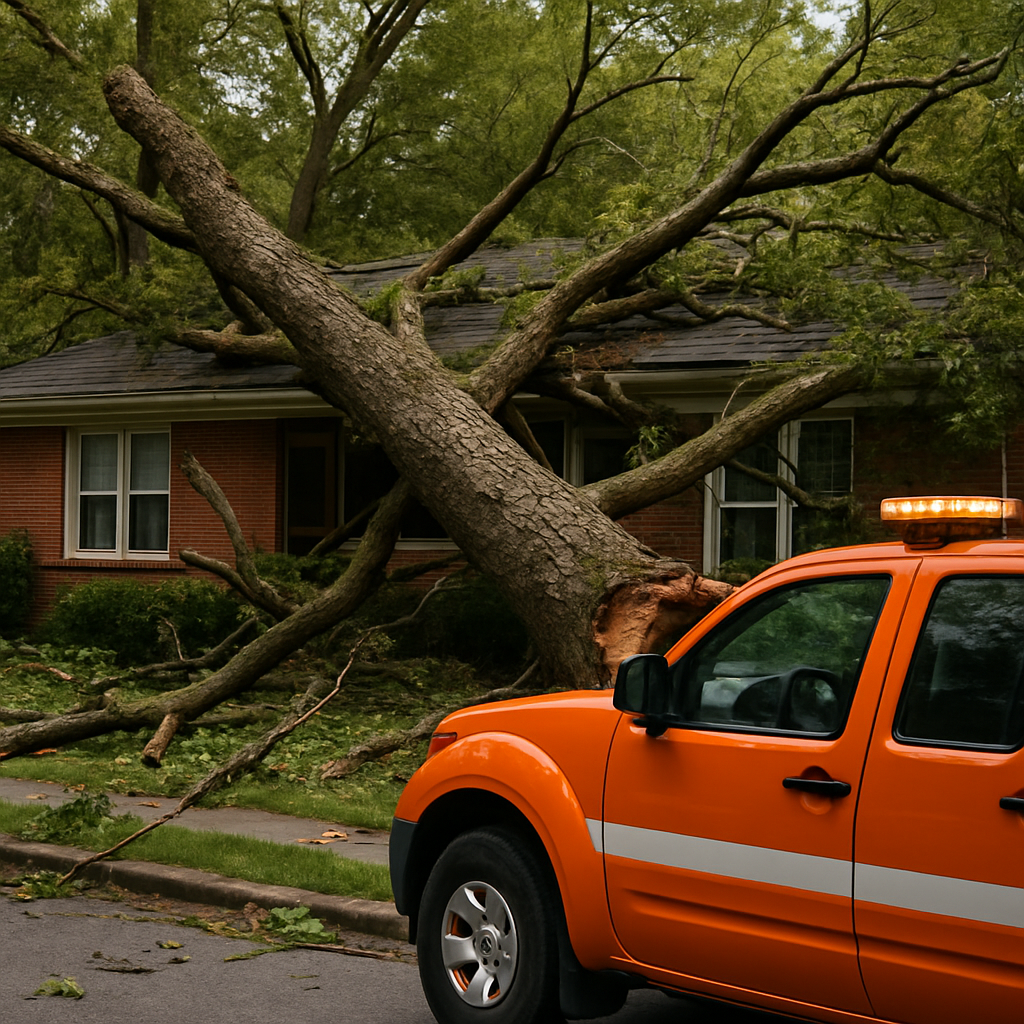
When a tree falls on your property time matters and one wrong move makes things worse. This guide shows how to secure the scene, document damage for insurance, and find reputable emergency tree removal near me fast, with exact phone scripts and vetting questions to use on the first call. You will also get realistic expectations about timelines, equipment, and costs so you can decide whether to wait for a certified arborist or authorize immediate removal.
Immediate Safety Checklist: What to Do First
Take human safety off the table first. If anyone is injured or trapped, call 911 immediately and keep bystanders well clear. Do not try to move injured people unless they are in immediate danger from fire or collapse.
Initial triage (first 5–15 minutes)
- Establish a perimeter. Keep people and pets at least 30 feet away from the tree and any downed lines; this reduces risk from sudden slips or shifting limbs.
- If you see downed electrical lines, call the utility and 911 before anything else. Utilities must de-energize or confirm lines are safe — no contractor or homeowner should touch them.
- Check for gas and smell warnings. If you detect a gas odor, evacuate and call your gas company from a safe location; do not flip switches or use lighters.
- Do not climb or cut tensioned branches. Tensioned wood stores energy and can release unpredictably; only trained crews with rigging should handle it.
- Move vehicles and unsecured valuables if it can be done safely. Photograph the scene first; moving objects before documenting damages complicates insurance claims.
Practical trade-off: delaying cleanup preserves evidence for insurance but can leave structures exposed to rain or theft. Make temporary, safe mitigation such as tarping a small roof hole only after photos and only if doing so does not put anyone at risk; save receipts for your claim.
Concrete example: A mature oak falls and rests on a detached garage roof without cutting the main support. The homeowner keeps everyone out of the garage, photographs the overhang from the driveway, calls the utility when a snapped limb is near a line, then contacts a 24/7 crew via Mr Tree Inc. emergency services to secure the site. The crew erects exclusion barriers and rigs a controlled removal the next morning after the utility confirms clearance.
What people get wrong. Homeowners often underestimate internal tension in branches and try to saw a visible limb free, which causes sudden collapse and property damage. In practice, calling a certified emergency tree service or licensed arborist is faster and cheaper than dealing with injuries or a botched DIY removal.
Next consideration: once the scene is stable, document everything with time-stamped photos and call a nearby emergency tree removal near me or a licensed emergency arborist for an on-site assessment; this moves you from triage to repair without creating new risks. For guidance on what an arborist will do after stabilization, see TreesAreGood storm aftercare.
How to Assess and Document Damage for Insurance
Immediate documentation protocol: start with a fast, repeatable sequence so nothing important is missed: whole-scene context, mid-range shots showing how the tree sits relative to structures, close-ups of penetration or crushed material, and finally photos of the tree root plate or break point. Capture short video walk-throughs while narrating what you saw and the time — insurers prefer a single, organized packet to a scatter of texts and photos.
Practical consideration and trade-off: spending 10–20 minutes to document carefully usually prevents disputes later, but do not delay emergency mitigation that reduces further loss. If rain or structural collapse is imminent, take the critical photos and a 30-second video, then authorize a safe temporary repair; keep receipts and include them with your claim.
How to preserve evidence that matters: keep large sections of the trunk or limb available for the adjuster when safe to do so, mark damaged vehicles with their license plate visible, and export photo metadata or use a photo app that embeds GPS and timestamps. Email the insurer a single PDF or zipped folder with a clear filename (example: 2026-04-13PropertyAddressClaimPhotos) so there is a time-stamped record you can reference.
| Item to record | How to capture | Why it matters |
|---|---|---|
| Overall property context | Wide shots from street and driveway showing house, tree, and neighboring landmarks | Proves location and relationship of damage to covered structures |
| Points of penetration or structural damage | Close-up photos of roof holes, crushed siding, dented vehicles with scale (ruler or coin) | Shows severity and supports repair cost estimates |
| Cause indicators | Photos of root plate, trunk failure, lightning scars, or rot | Helps determine whether the loss is sudden (covered) or maintenance related (may not be) |
| Utilities and hazards | Image of downed lines, utility poles, and the utility company ticket number | Documents coordination with utilities and assigns responsibility where applicable |
| Mitigation and invoices | Photos of tarps, temporary shoring, and scanned receipts or crew estimates | Supports emergency remediation coverage and reimbursement |
Concrete example: after a windstorm a maple uproots and leans into a garage. The homeowner records a 45-second video showing the tree from the street to the garage door, then takes close photos of the cracked garage rafter and the exposed root plate. They email the insurer the files that evening, include a short written timeline of events, and keep the largest limb segments until the adjuster inspects them the next day.
Send one organized submission to your insurer within 24 hours: photos + video + short written timeline + receipts. A single packet speeds claim intake and reduces back-and-forth.
Judgment call homeowners miss: insurers look for evidence of proximate cause. If a tree shows chronic decay or prior lean, expect questions — proactive photos of pre-storm condition (pruning, pest reports) reduce friction. Do not assume a contractor's verbal promise will substitute for documentation; insist on written estimates and save every invoice.
Next consideration: before authorizing any major removal, contact your insurer and ask whether they require an adjuster onsite prior to disposal; get that instruction in writing so you can proceed with a licensed emergency tree service without jeopardizing your claim. For insurers guidance see How to document storm damage for your insurance claim.
Finding Emergency Tree Removal Near Me: Fast Search and Triage
Cut the search time in half by triaging vendors before you call. When you search for emergency tree removal near me, your immediate goal is not to read every review — it is to sort responders into three practical buckets so you can pick the right response level for the hazard.
Triage buckets and when to use them
Immediate intervention: hazards that threaten life, a roof, a vehicle, or utility infrastructure. Call 911 or the utility if life or energized lines are involved, then a same day crew with heavy rigging experience. Priority same day: large limbs blocking driveways, trees that could fail onto structures within 24 hours. Defer to next day: debris in lawn or sidewalks that is inconvenient but not immediately dangerous.
Practical insight: speed and competence trade off against price. The fastest crews often charge emergency premiums and may subcontract complex rigging to specialists. If the tree is under tension or on a structure, prioritize certified arborists and crews with cranes or bucket trucks even if they cost more; the risk of a botched removal is real and expensive.
A three sentence calling script that gets you an ETA and real capability
Script: I have a [city name] address with a tree affecting a roof/vehicle/driveway and a possible utility hazard. Can you confirm you operate 24/7, have a certified arborist on staff, and send a crew with rigging/crane if needed? What is your ETA and do you require a deposit to start emergency triage? Use this to force useful answers fast and get a quoted arrival time.
Quick vetting heuristics that matter in practice: look for recent emergency photos on the company profile, calls answered by a dispatcher instead of voicemail, clear language about 24 hour response, and an emailed estimate or work order before crews begin. Do not rely solely on review counts; older five star reviews are not evidence of emergency competence.
- What to ask when you need a same day crew: confirm insurance certificate number, whether crews can work near utilities, what heavy equipment they will bring, and whether they will handle haul away and stump grinding.
- Payment and permits: insist on an emailed scope with line items so you can send it to your insurer; avoid full cash payments up front.
- When to call out a utility first: if wire contact is visible or the tree is on a pole, contact the utility before any contractor.
Concrete example: A property manager finds a pine fallen across a loading bay at 7 AM. They call using the script above, get a 90 minute ETA from a crew that lists emergency crane work on their profile, receive an emailed work order with insurance info, and authorize the crew to secure the bay. The crew uses tag lines and a small crane to lower heavy sections safely that afternoon, avoiding secondary roof damage.
Judgment most homeowners miss: the fastest quote is not always the best option. If crews offer rapid removal but cannot show recent emergency work photos or a certified arborist, the apparent speed may mask unsafe shortcuts. Prioritize documented capability over pressure tactics.
If you need a single place to start, call a company that publishes an emergency services page and immediate contact line such as Mr Tree Inc emergency services so you get triage questions, ETA, and documentation in writing.
Next consideration: after you pick and confirm arrival, keep a short record of the call time, the responder name, and the emailed estimate so you can compare arrival performance and preserve evidence for insurance or dispute resolution.
How to Vet an Emergency Tree Contractor Quickly
Start with the minimums that actually matter. When you search for emergency tree removal near me you need three verifications before you consider price or ETA: active insurance, demonstrable emergency capability, and a written scope you can show your insurer.
A three-minute verification framework
Minute 1: Verify insurance and authorization. Ask for a certificate of insurance (COI) with policy numbers for general liability and workers compensation. Call the insurer or look up the policy online if a carrier is listed; fake COIs are real. If the job touches a utility, confirm the company will coordinate with the utility or is authorized to work near lines.
Minute 2: Confirm emergency experience and tools. Request recent emergency job photos or a quick email with a roster of equipment (crane, bucket truck, chippers). Crews that routinely handle urgent storm damage will show timestamped photos or a dispatcher who answers live. If they only offer vague assurances, assume risk.
Minute 3: Lock down the scope and payment terms. Get a one page emailed work order that lists the hazard being removed, whether stump grinding is included, haul away, permit handling, and accepted payment methods. Refuse full upfront cash payments; a reasonable emergency deposit is normal, but final payment should follow completion and a signed invoice.
- Ask on the call: Who is the on site crew leader and are they ISA certified? Can you email their name and the COI now?
- Subcontracting check: Will this crew perform the work or will you subcontract? If subcontracted, get that subcontractor's insurance info too.
- Utility protocol: If lines are nearby, will you wait for utility clearance or work under a written utility permit?
Trade-off to accept in true emergencies. Fast response often means paying an emergency premium and accepting fewer bids. That is fine if the contractor clears the three-minute checks above. Trying to save money by vetting slowly or accepting the cheapest immediate quote is where most homeowners get burned.
Common mistake and practical judgment: People put too much faith in star ratings and old reviews. In practice the most reliable signal is a live dispatcher, an emailed COI and work order, and evidence of recent emergency work in the last 6 months. If a company resists any of those, move on.
Concrete example: A rental manager called three companies after a storm. Company A answered immediately but could not email a COI; Company B sent a COI and recent crane photos within 10 minutes and gave a two hour ETA; Company C required full cash up front. The manager hired Company B, verified the COI by phone with the insurer, and avoided a short staffed crew that later failed to secure the scene.
If you must pick one action now: get an emailed COI and a one-line work order before crews arrive; it prevents most scams and preserves your insurance claim.
Next consideration: after the contractor passes the three-minute checks, keep a brief record of the call time, the emailed COI/work order, and the ETA so you can compare performance and provide clear documentation for your insurer or municipal reviewers. If you want a known starting point, begin with a company that publishes emergency procedures like Mr Tree Inc emergency services.
What to Expect During Emergency Tree Removal
Practical reality: emergency tree removal is a prioritized construction problem, not routine yard work. When you search for emergency tree removal near me, crews arrive to eliminate immediate hazards first, then move into controlled dismantling, not a fast aesthetic cleanup. Expect decisions on site that trade speed for safety and property preservation.
On site workflow and decision points
Stage 1 – Stabilize and isolate: crews set exclusion zones, secure leaning sections with rigging, and confirm utilities are safe. Stage 2 – Tactical cuts: arborists plan sectional cuts to remove weight and tension in a predictable sequence. Stage 3 – Mechanical lowering and haul away: pieces are lowered to a chipper or truck using ropes, cranes, or bucket trucks. Stage 4 – site mitigation: temporary repairs, stump options, and debris removal follow once the hazard is resolved.
- Common equipment: chainsaws for precision cuts and
stump grinderfor post removal work. - Heavy gear: cranes and bucket trucks when sections cannot be safely lowered by hand.
- Material handling:
chipperand skid steer for chips and haul trucks for logs and debris. - Rigging kit: block and tackle, tag lines, and harness systems to control tensioned limbs.
Timing and tradeoffs: small, non tensioned yard trees can be cleared in a few hours. Large or structure involving removals are whole day operations and sometimes require multi day coordination with the utility or a crane operator. Using heavy equipment speeds removal and reduces risk to crews but increases ground disturbance and cost – expect crews to protect driveways where possible, and to present options that balance property impact versus immediate hazard removal.
Cost reality: expect a baseline from a few hundred dollars for straightforward small trees, mid range work typically into the low thousands when access or size adds complexity, and complex jobs involving roofs, cranes, or utility coordination to reach several thousand dollars or more. Always get a written scope that separates removal, haul away, stump grinding, permit fees, and any emergency premium.
Concrete example: A 60 foot oak snapped and settled on a back porch roof. The crew first cordoned the yard and tied the crown to remove weight safely. A crane was scheduled after the utility confirmed lines were de-energized. The operation ran ten hours between stabilization, sectional crane lifts, roof protection, and debris hauling, with stump grinding scheduled for a later date to avoid adding to the immediate scope.
Judgment homeowners miss: the cheapest same day option often uses smaller crews and riskier cutting shortcuts. In practice, pay a verified emergency premium if the crew demonstrates insurance, recent emergency experience, and the right equipment. If you want a single place to start that publishes emergency procedures and triage, see Mr Tree Inc emergency services and review insurer guidance at How to document storm damage.
After Removal: Follow Up Safety, Repairs, and Tree Care
Do not treat removal as the end of the problem. Even after crews clear the hazard, there are immediate safety tasks, repair decisions, and ongoing tree-care steps that determine cost, liability, and long-term risk.
Practical trade-off: schedule follow-up work quickly to limit secondary damage, but avoid irreversible actions until you know what the insurer and an arborist require. Rushing permanent repairs or disposing critical debris can speed closure but risks claim denial or missed evidence.
Post-removal checklist to schedule within 30 days
- Confirm final documentation: Ask the crew for an itemized invoice, photograph record of the removal, and the COI used onsite so you can forward a single packet to your insurer and contractors.
- Stump plan: Decide on grinding depth and backfill now. Typical recommendation is grinding 6–12 inches below grade for residential lawns; deeper grinding reduces regrowth but raises cost and ground disturbance.
- Structural repair triage: Get a licensed roofer or contractor to provide a temporary stabilization quote and a permanent repair estimate; keep temporary measures separate on invoices for insurance clarity.
- Arborist follow-up inspection: Schedule a certified arborist to check remaining trees for root damage, cambium injury, or transferred pathogens—these problems often show up weeks after a failure.
- Wood disposition: If you want firewood, specify split length, drying expectations, and stacking location in writing; otherwise have the crew haul away and note that hauling often lowers pest and liability risk.
Limitation to accept: stump grinding schedules and arborist reports can be delayed in busy seasons. If you wait months, expect regrowth, fungal colonization, or additional stabilization costs. Plan for follow-up within the first planting season to avoid compounding repairs.
Concrete example: After a late-summer storm a homeowner had a large elm removed and signed off on the removal invoice. They delayed stump grinding until autumn; by then the stump had produced multiple shoots and fungal decay, requiring a deeper, more expensive grind and removal of infected soil. If they had booked stump grinding within the same month and requested an arborist check, they would have reduced repeat work and cost.
Actionable judgment: insist that stump grinding, haul away, and any wood left on site appear as separate line items on the final invoice; this prevents surprises when you submit receipts to your insurer or decide to keep the wood for firewood.
For replacement planting, soil remediation, or long term health plans, request a written management plan from a certified arborist. That plan should include timeline, species recommendations, and monitoring checkpoints at 6 and 12 months so you can document recovery for both property value and future claims.
If you want a single, practical next move: book stump grinding and a post-removal arborist inspection within 30 days. If you prefer a vendor who can do both and provide an itemized invoice for insurance, see Mr Tree Inc stump grinding and Mr Tree Inc arborist services.
How Mr Tree Inc. Handles Emergency Calls and What to Expect
Direct statement: Mr Tree Inc. runs emergency calls like a triage center: intake to establish immediate risk, verification to confirm capability and insurance, then field dispatch for stabilization or removal. The goal is not always immediate total cleanup but to neutralize the hazard in the safest, fastest way available.
Phone intake in practice: When you call the emergency line you will be asked for address details, a one sentence description of the hazard, whether anyone is injured, and whether lines or structures are involved. Expect the dispatcher to request photos or a short video you can text or email; that speeds an accurate ETA and tells the crew which equipment to load.
On site process and limits
On site assessment: a certified arborist or crew lead performs a quick hazard assessment, sets exclusion zones, and decides between temporary stabilization and sectional removal. If a utility must de-energize lines or a crane is required, the crew will stabilize and return when the specialist clears or the crane arrives. That staged approach reduces risk but can extend the job across hours or days.
Paperwork and payment: crews arrive with a COI, a short written scope, and a line item estimate that separates removal, haul away, stump grinding, and any emergency premium. Mr Tree accepts common electronic payments and staggered payments tied to milestones; insist on the written scope and avoid full cash payment up front.
Practical tradeoff: fastest possible response often means an emergency fee and narrower bidding. In high risk situations accepting a verified, pricier crew buys predictability and limits secondary damage. Conversely, pressing for the cheapest same day option frequently results in shortcuts or subcontracting.
Concrete example: A homeowner reported a heavy limb resting on a porch roof. The dispatcher asked for photos, sent a two person crew for stabilization within 90 minutes, and scheduled a crane once the utility cleared nearby lines. The crew tied the crown and removed weight to make the porch safe, then returned the next morning with a crane to complete sectional lifts and haul away debris.
Judgment homeowners miss: a promise to be at a property in one hour means different things. For simple, non tensioned cleanups it is realistic. For trees on roofs or near energized lines it usually means an initial triage visit, not final removal. Treat the arrival time as the start of a controlled operation, not the finish.
Next consideration: if you need a single practical contact start with an emergency services page and hotline such as Mr Tree Inc emergency services or use the direct contact on Mr Tree Inc contact so you get triage questions, an emailed work order, and a documented ETA to move from hazard to repair.
0 Comments