
Choosing a Tree Removal Company: Licenses, Insurance, and What a Fair Estimate Looks Like
When you need a tree removed, choosing the right tree removal company decides whether the job is safe, insured, and worth what you pay. This practical guide walks through the exact licenses and insurance proof to request, shows how to compare written estimates line by line, and highlights the red flags that mean you should walk away. Youll also see real-world example estimates for small, medium, and large jobs so you can judge bids with confidence.
Why careful selection matters for safety and liability
Key point: Choosing the wrong tree removal company hands you more than a bill — it can transfer legal exposure, repair costs, and time-consuming claims work to your shoulders. The invoice for removing a tree is often the smallest cost compared with fixing a roof, replacing a vehicle, or defending a liability suit after a mishap.
How liability actually reaches you
Pathways of risk: When a crew damages your neighbor's fence, hits a utility line, or an employee is injured on your property, responsibility is determined by insurance coverages, state labor law, and contract language. If the contractor lacks adequate policies or the policy is lapsed, your homeowner policy or pocket pays first and you may face higher premiums or uncovered losses.
- Property damage: falling limbs can crush roofing, siding, vehicles, or HVAC units; repairs are costly and slow down occupancy or use of the property
- Personal injury: a worker or bystander hurt during removal can trigger third party claims and lawsuits that involve you unless the contractor carries appropriate liability and workers compensation
- Permit and code violations: removing certain trees without a permit can lead to municipal fines or required remediation that the homeowner must handle if the contractor did not obtain permits
- Business continuity: for commercial properties, a botched removal can close an entrance, block operations, or create safety citations that affect your bottom line
Tradeoff worth thinking about: A lowest-price bid often omits safety measures that protect adjacent structures, like crane-assisted lifts or staged rigging. Paying more upfront for proven methods usually reduces the chance you will spend several times that on emergency repairs and liability exposure later.
Concrete example: A homeowner hires an affordable local crew to remove a leaning oak near the garage. During dropping, a limb tears through the garage roof. The crew had no workers compensation on file and limited liability limits. The homeowner faced out-of-pocket repairs and an insurance claim that raised the policy deductible fight. Had the job been contracted to a verified, insured tree removal service using crane-assisted rigging, the homeowner would likely have been insulated from those costs and the disruption.
Always confirm active coverage and whether your property will be named as an additional insured on the contractor certificate of insurance before work begins.
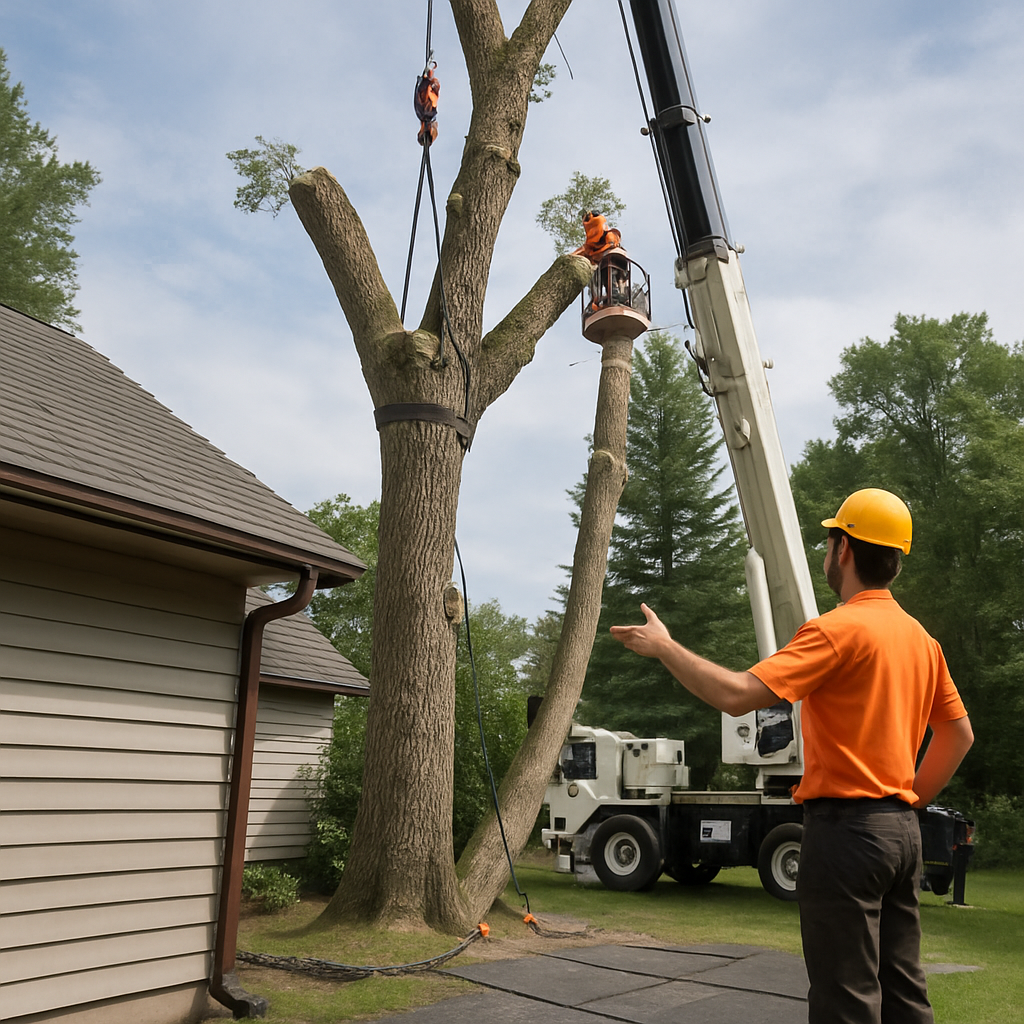
Next consideration: Before you request final bids, prepare to verify insurance and permits so the contractor selection is based on risk control, not just price. For a model of documented, transparent estimates, see Mr Tree tree removal services and consult safety guidance at International Society of Arboriculture and OSHA.
Which licenses and credentials to verify
Key filter: treat credentials as the first real screen when evaluating a tree removal company; they separate a professional crew from a risky one and are easy to check before you book work.
Ask for and verify three categories of credentials: legal business and contractor licenses, industry qualifications, and local permitting responsibility. These items matter differently depending on the job – a small backyard removal needs less technical oversight than a large hazardous tree near power lines.
What to request and why each matters
- State contractor license or registered business number – confirms the company is permitted to offer tree work in your state and links them to complaints or disciplinary records.
- International Society of Arboriculture certified arborist – valuable when the job involves tree health decisions, advanced pruning, or preservation; a certified arborist adds documented expertise, not just muscle.
- Local permits or municipal tree work authorization – many cities require permits for removals or for protected species; confirm whether the contractor will obtain permits or if that responsibility is yours.
- Equipment and operator qualifications – look for identifiers for crane-assisted or bucket truck operators when those tools are in the estimate; fine print on operator certification matters for complex rigging.
- Local business presence and references – a local address and recent references reduce the risk of disappearing after payment and mean easier recourse if something goes wrong.
Tradeoff to weigh: hiring a company with a certified arborist typically raises the bid but reduces the chance of unnecessary removals or poor pruning. If your tree has high value – historic, large, or close to structures – budget for arborist oversight; saving on credentials often costs more later.
Concrete example: a property manager had a 70 year old maple flagged for removal. A certified arborist from the selected tree removal service identified a manageable root issue and recommended targeted pruning and soil work instead of removal. The manager avoided a multi thousand dollar removal and preserved a canopy that added rental value.
How to verify without getting bogged down
- Get identifiers up front – request a license number, the certified arborist ID, and the business registration name in writing.
- Check official databases – confirm contractor licenses on your state licensing portal and verify ISA credentials at International Society of Arboriculture.
- Request document scans – ask for a photo or PDF of the license or certificate; legitimate companies will email these without hesitation.
- Phone a verifier when in doubt – call the issuing agency or ISA to confirm the number is active rather than relying on the contractor alone.
Sample script for email or phone: Please send your state contractor license number and a copy of your ISA certified arborist certificate. Also confirm who will obtain required municipal permits for this job and whether the company name will appear on those permits.
If a contractor resists providing license numbers or certificate scans, treat that as a disqualifier – transparency on credentials is a basic professional standard.
When you prepare for bids, print this checklist and cross reference each candidate. Do not accept verbal assurances about licensing – get numbers and verify them. For more on certified arborist roles and when to require one, see Mr Tree arborist services and guidance at International Society of Arboriculture.
Insurance and bonding explained and how to confirm them
Insurance and bonding are not optional paperwork; they determine who pays when something goes wrong. For a tree removal company you should treat three insurance lines as mandatory: general liability, workers compensation, and commercial auto. Bonding is separate and shows a contractor has a financial guarantee for performance or permit conditions on public or municipal jobs.
What to request from every bidder
- Certificate of Insurance (COI): ask for a current COI that lists policy numbers, effective and expiration dates, and the insurer phone number.
- Additional insured endorsement: request that your property or company be named as additional insured on the general liability policy if the contract requires it.
- Waiver of subrogation: ask whether the policy includes a waiver so the insurer cannot pursue you after a claim.
- Bond documentation when applicable: for public permits or required restoration ask for the bond type, bond number, issuer, and contact.
- Confirm hired auto and equipment coverage: chippers, trailers, and dump trucks must be covered by commercial auto or the insurer may deny third party claims.
Practical verification step: call the insurer using the phone number on the COI and give them the policy number. Ask if the policy is active, whether the certificate includes the named additional insured, and whether there are exclusions for the type of work you are hiring for. Do not rely solely on an emailed PDF from the contractor without this quick confirmation.
| Policy / Bond | What it covers | When higher limits or bonds matter |
|---|---|---|
| General liability | Third party property damage and bodily injury from operations | Large trees close to structures or jobs requiring cranes |
| Workers compensation | Medical and wage claims for injured employees | Always required; gaps shift claims to the property owner |
| Commercial auto | Damage caused by trucks, chippers, or trailers while in use | Essential when debris hauling or heavy equipment transport is part of the job |
| Umbrella | Extra coverage above primary policy limits | Useful for complex removals and commercial sites |
| Performance / permit bond | Guarantees contract completion or municipal remediation | Often required on public work, permits, or large lot clearing jobs |
Tradeoff to understand: higher coverage costs show up in estimates, but they buy transfer of risk for you. For example, a crane assisted removal near a roof creates exposure far beyond routine pruning; insisting on umbrella coverage or higher limits is reasonable. Conversely, a small backyard pruning job may not justify extra endorsements if confirmed by inspection.
Concrete example: after a storm a property manager hired a local crew to remove fallen limbs and the crew used a personal pickup for hauling. A parked car was scratched during loading. The contractor had no commercial auto on file and the homeowners claim payment was delayed while insurers argued coverage. The manager now requires commercial auto confirmation and insurer verification on every COI for emergency tree removal work.
If a job requires permits or heavy rigging, ask for bond details and umbrella limits before you sign.
For a documented approach tie these checks to the estimate request. Use this sample request when you call or email a tree cutting company: Please send a current COI with policy numbers and insurer contact, confirm whether our property can be named additional insured, and provide any bond documentation required by the municipality. For a template and more on arborist roles see Mr Tree tree removal services and guidance from the International Society of Arboriculture.
What a fair written estimate should include and a sample breakdown
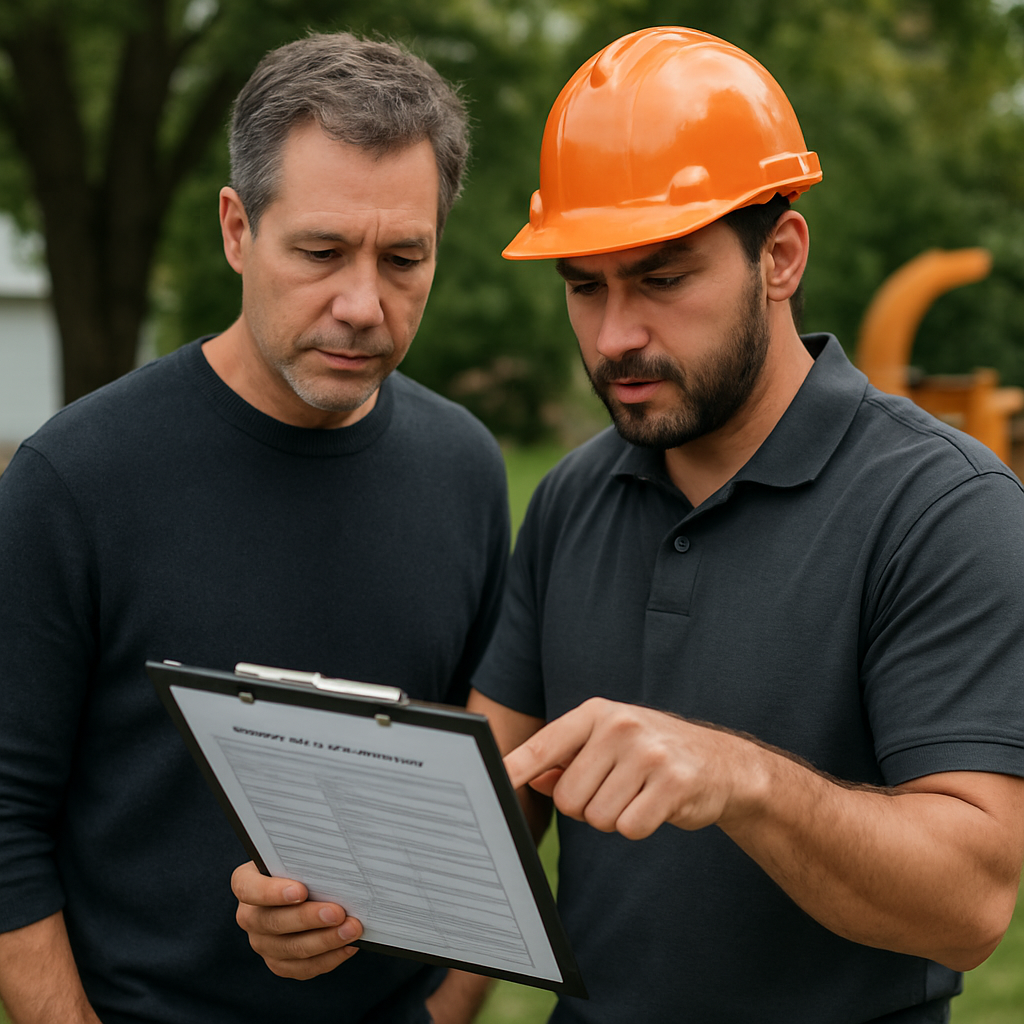
Direct standard: A fair written estimate from a tree removal company separates scope, risk, and extras so you can compare bids line by line rather than by a single lump sum. If the document only gives a total price, it is not an estimate you can trust for apples-to-apples comparison.
Core elements every honest estimate contains
Must-see entries: The estimate should list site assessment or permit coordination, crew hours or labor, equipment (crane, bucket truck, chipper) with daily rates if rented, stump grinding, hauling/disposal, site protection/cleanup, taxes, and any municipality fees. Contingency for hazardous or hidden conditions should be explicit rather than buried later as a surprise change order.
| Line item | Why it matters | Sample cost (small / medium / large) |
|---|---|---|
| Site assessment & permits | Covers time to evaluate hazards and obtain municipal permissions where required | $50 – $200 / $100 – $400 / $200 – $800 |
| Tree removal (labor & crew) | Direct labor and time for rigging and cutting; increases with height and complexity | $300 – $700 / $800 – $2,000 / $2,500 – $8,000+ |
| Equipment rental/usage | Crane, bucket truck, or specialty rigging protects structures but adds cost | $0 – $200 / $200 – $1,500 / $1,500 – $6,000 |
| Stump grinding | Leaves the site ready for planting or grading; omission is a common lowbid gap | $100 – $250 / $200 – $600 / $400 – $2,000 |
| Hauling & disposal | Chipping on site vs hauling to landfill affects price and post-job mess | $0 – $150 / $100 – $400 / $200 – $1,200 |
| Site cleanup & restoration | Raking, turf repair, and final debris removal; often negotiated separately | $50 – $150 / $150 – $500 / $300 – $1,000 |
| Contingency / hazardous conditions | Explicit allowance for unseen rot, utility conflicts, or storm damage | $50 – $150 / $200 – $600 / $500 – $2,000+ |
Practical insight: Low bids frequently omit hauling, stump grinding, permits, or contingency. That looks cheap until you get a change order. Require each bidder to mark which of these items are included; a higher total that is comprehensive is often the safer, more economical choice when you factor in risk and follow-up work.
Concrete example: A homeowner had a 70 ft elm leaning toward a garage. One company quoted $2,200 for removal and left stump grinding as an add-on; another quoted $3,800 including crane-assisted lifts, stump grinding, permit handling, and cleanup. The lower bid saved $1,600 up front but the final invoice after required permits and emergency roof protection pushed costs above the higher, all-in quote. The all-in estimate also reduced scheduling risk and contractor back-and-forth.
- Judgment call: Accept a ballpark only to shortlist; insist on a detailed, signed written estimate before any deposit.
- Tradeoff: Detailed, signed scopes lock price but require the contractor to surface unknowns; expect reasonable change-order clauses for genuinely hidden conditions.
- Compare: Normalize bids by asking each company to state exactly what they will leave on site (chips, mulch), what they will haul, and who pays permit fees.
Next consideration: When you have two similar totals, choose the bid that documents insurance, arborist oversight, and permit responsibility in writing — the small premium buys protection most homeowners need.
How to compare estimates apples to apples
Start with a reproducible method. When you get three bids from a tree removal company you are comparing more than price — you are comparing risk transfer, scope clarity, and how much work the contractor will actually do. Turn those subjective differences into a simple numeric score so comparisons are objective and defensible.
A simple weighted scorecard you can use today
Score each bid 0 to 10 on the criteria below, then convert to weighted points. This forces bidders to compete on documented scope and protections, not just who shouts the lowest number.
- Safety & insurance (30%): active COI, additional insured, umbrella limits, and verified commercial auto.
- Scope completeness (20%): explicit permit handling, stump work, hauling, and contingency language.
- Equipment & arborist oversight (15%): whether crane or certified arborist is included when needed.
- Price transparency & contract terms (15%): itemized charges, payment schedule, and change-order rules.
- Cleanup & disposal (10%): who removes chips, level of site restoration, and turf repair commitments.
- References & warranty (10%): recent local jobs and any short-term workmanship warranty.
Multiply each 0–10 score by the criterion weight divided by 10, then add. A perfect bid scores 100. Use the outcome to rank bids and to justify follow-up verification (for example, calling the insurer or asking for the arborist ID). This process exposes low bids that skip real protections.
Concrete example: A homeowner compares three bids for a large maple threatening a garage: Bid A $2,200, Bid B $3,900, Bid C $3,200. Using the scorecard Bid A totals 40.5 (cheap but weak on insurance and rigging), Bid B totals 79.5 (full COI verified, crane and ISA arborist included), Bid C totals 67 (all-in but less robust insurance limits). Given the proximity to the garage, Bid B earns the hire — the premium buys documented risk transfer and reduces chance of a costly follow-up claim.
Practical tradeoff: a higher numerical score often correlates with a higher price. That premium is justified when the job has asymmetric downside – large tree near structures, limited access, or required municipal permits. For low-risk, small removals you may accept a midscore bid; for anything that can create outsized damage, prioritize scores tied to insurance and rigging over the absolute bottom line.
Normalize before you score: ask every bidder the same short set of written confirmations — will you obtain permits, is stump grinding included, will chips be hauled, and can you email a current COI — then score only on those aligned scopes.

Next step: use this scorecard alongside calls to verify COIs and license numbers. If you want a model estimate and how Mr Tree lays out itemized scope and insurance evidence, see Mr Tree tree removal and check best practices at International Society of Arboriculture.
Top red flags and questions to ask before hiring
Start here: The fastest way to eliminate risky bidders is to watch how they respond to basic paperwork and simple questions. If a candidate hesitates, fumbles details, or insists on informal terms, that behavior usually predicts problems on the job.
Common red flag categories
- Documentation gaps: missing or vague insurance evidence, no verifiable license number, or refusal to provide written estimates.
- Payment and contracting behavior: demands for large cash deposits, pressure to pay in full before work, or refusal to sign a clear scope of work.
- Operational warning signs: crews without badges or uniforms, no site protection plan for nearby structures or utilities, and vague answers about equipment or permits.
Practical insight: A reactive contractor who promises to sort paperwork after the fact is acceptable only for emergency stabilization – not for full removals. For non emergency jobs, require verifiable documents before any crew arrives.
Twelve direct questions to ask on the call or site visit
- What is your exact business name and state license number? – Write it down and verify online.
- Can you email a current Certificate of Insurance with policy numbers and insurer phone? – Expect same day delivery.
- Will you name my property as additional insured on the general liability policy? – Yes is preferred for high risk jobs.
- Do you carry commercial auto and workers compensation? – If no, stop the conversation.
- Who on your team is the ISA certified arborist and what is their ID? – Get the name and confirm at International Society of Arboriculture.
- Who will obtain required municipal permits and whose name appears on them? – Permit responsibility must be explicit.
- What equipment will you use and who will operate it? – Ask about crane or bucket truck operator credentials if relevant.
- Is stump grinding included or priced separately? – Missing stump work is a common low bid gap.
- How will you protect adjacent structures and landscaping during removal? – Listen for a concrete plan.
- What is your payment schedule and what portion is due before completion? – Keep deposits modest – 10 to 30 percent is normal.
- Can you provide three recent local references for similar jobs? – Call at least two.
- What is your change order process for hidden hazards discovered during work? – Expect written approval for any extras.
Concrete example: A commercial property manager agreed to immediate lot clearing after a lease negotiation. The contractor began work with a handshake and a 50 percent cash deposit. Permits were later required, fines were issued, and the manager had to chase the contractor for remediation because the company had no municipal bond. That sequence is avoidable by requiring permit confirmation and bond evidence before work starts.
Short phone script: Hi, I need a written estimate. Please email your business registration, state license number, and a current COI that shows general liability and commercial auto. I will confirm with your insurer before scheduling. Short email script: Please attach your license, ISA arborist ID, and COI. Confirm who will pull permits and whether stump grinding and hauling are included.
Next action: request the documents, make one verification call to the insurer, then shortlist. Do not hire on a verbal promise even if the price is attractive.
What to expect during the job and final payment checklist
On-site reality: A professional tree removal company runs like a short construction project — a morning safety brief, a clear chain of command, and visible site controls. Expect the crew lead to walk the site with you, point out the drop zone and exclusion perimeter, and identify who on the team is the supervising arborist (if one is assigned). If those basic signals are missing, you are looking at an informal crew rather than a professional service.
On the day: operations and protections you should see
Crews that know what they are doing make predictable, visible choices to protect your property and reduce surprises. Look for preplaced plywood or track mats over lawn and driveways, marked pedestrian barriers, a cleared and signed drop zone, and chippers parked to minimize soil compaction. The crew should show you where chips will go (left as mulch versus hauled off) and point out any utility protection or cribbing that will be used near foundations or lines.
- Visible signs of a professional crew: tailgate safety briefing with PPE in use
- Site control: exclusion tape, cones, and a single gated access for equipment
- Documentation on hand: permit or job ticket and an emailed COI accessible on a phone or tablet
- Equipment checks: inspection tags or documented maintenance on cranes/chippers
- Daily record: brief written log or sign-in sheet showing who worked and key events
Payment structure that works: Tie payments to milestones in the contract rather than vague phrases like complete or finished. Typical milestones are mobilization, main tree removal, stump grinding/hauling, and final cleanup/inspection. A modest retainage held until the final walkthrough is your leverage to get punch-list items corrected; the tradeoff is a slightly longer final settlement but far fewer unresolved issues.
Final deliverables to require before you pay the balance: Provide these as contract line items so expectations are enforceable. Itemized final invoice that matches the signed estimate line by line; lien waivers from the contractor and any primary subcontractors; proof of disposal such as a landfill receipt or transfer ticket if debris was hauled away; photo documentation of work areas and any protection measures; and a short completion statement signed by the crew lead that notes no outstanding damage or hazards.
Concrete example: A homeowner withheld the retainage until the contractor delivered signed lien waivers and a weigh ticket from the transfer station. The contractor returned the same afternoon with the documents; the homeowner released final payment. Months later a neighbor filed a claim for a boundary stump removal — because the homeowner had the disposal ticket and signed completion statement, the claim was resolved without the homeowner paying additional fees.

Next consideration: Before you sign, add the deliverables above to the contract and schedule a short final walkthrough time. Insist that the contractor provide the documents electronically the same day as the job so you can verify them while the crew is still on site.
How Mr Tree approaches estimates, safety, and post-job follow up
Straight answer: Mr Tree treats an estimate as a risk plan, not a price quote. Instead of handing you a single lump sum, a Mr Tree estimator documents hazards, proposes alternative removal methods (manual rigging versus crane-assisted tree removal), and gives three clear scopes so you can choose the cost-risk balance that fits your property.
How estimates are structured
On site Mr Tree combines a brief arborist assessment with a safety-rating for the crew and the neighborhood. The written estimate includes a primary recommended approach and one or two lower-cost options that cut scope (for example, remove only the canopy vs remove + stump grinding). Each option lists what is intentionally excluded so you do not discover hidden costs later. This is practical: homeowners often accept a cheaper option only to pay more later because exclusions were vague.
Tradeoff to understand: the cheapest option usually shifts risk back to you. If a tree sits near a roof or utility line, the estimator will flag when extra endorsements or an umbrella policy are worth the premium. Expect Mr Tree to price that protection separately so you can see the cost of transferred risk clearly.
Safety checks Mr Tree runs before crews arrive
Mr Tree verifies active insurance, confirms the assigned ISA certified arborist when arborist services are part of the job, and checks operator qualifications for any specialized equipment. They record insurer contact details and policy numbers in the job file and re-verify them before mobilization for higher-risk jobs like crane lifts or commercial projects.
A realistic limitation: verifying extras like additional insured endorsements or specific umbrella amounts takes time. For emergency tree removal Mr Tree will stabilize the hazard first, then complete the full verification before removing large trees unless immediate action is necessary to protect life or property.
Concrete example: A homeowner had a 60 ft silver maple threatening a garage. Mr Tree provided three written scopes: a basic drop-only removal, a crane-assisted removal with stump grinding, and a preservation plan with targeted pruning. The homeowner chose the crane option; Mr Tree delivered a COI that named the homeowner as additional insured, used crane-certified operators, returned a transfer-station weigh ticket, and scheduled a 72-hour site check to confirm no hidden damage.
- Digital job folder: before/after photos, COI copy, operator IDs, and permit receipts sent the same day
- Follow-up timeline: 48–72 hour site check for settling/compaction and a 30–90 day tree health check if live trees remain nearby
- Customer support: a direct number for storm or emergent concerns and a 14 day punch-list window for cleanup items
When you call, say: Please email the detailed estimate and the COI before scheduling. I will confirm coverage and pick the scope that reflects the risk I want transferred. Contact Mr Tree at Contact Mr Tree.
0 Comments