

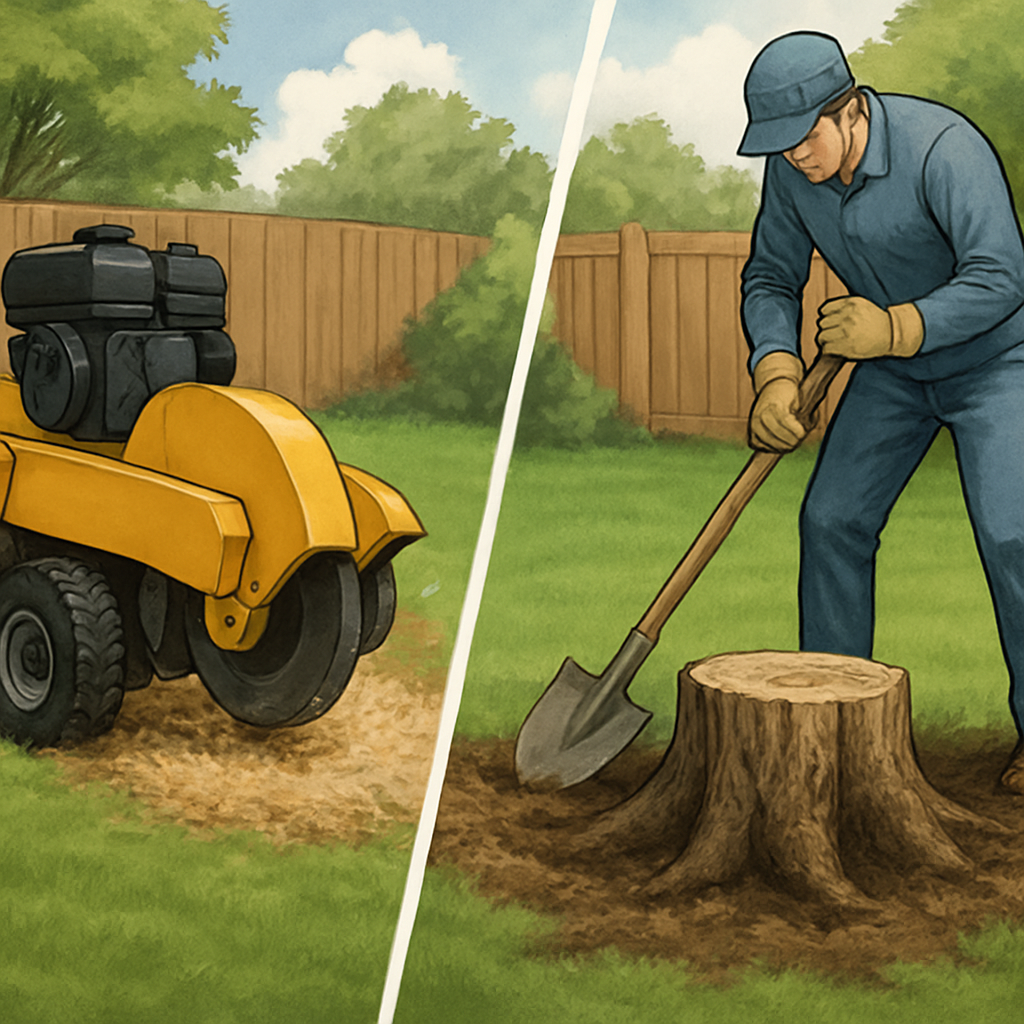
A leftover stump can derail landscaping plans, create a tripping hazard, or invite pests if you leave it to decay. This article compares stump grinding and full stump removal, explaining how each process works, realistic cost ranges, site impacts, and timelines for replanting. You will get a practical decision checklist and the key questions to ask before hiring a stump grinding or stump removal contractor.
How stump grinding works
Core action: Stump grinding uses a rotating cutting wheel with carbide teeth to mechanically mill the exposed stump into chips, reducing the visible wood to a few inches below grade while leaving the bulk of the root system in the ground.
What the crew does step by step: The operator inspects site access and hazards, secures the work area, positions a commercial grinder, mills the trunk and root collar to the agreed depth, and cleans or removes the chips. A typical job also includes light backfilling with the grindings or clean soil to restore grade.
Equipment, depth, and what remains
Equipment choices matter: Compact grinders handle tight yards and small stumps; heavier Vermeer or Husqvarna style machines are needed for large diameter trunks and stubborn root collars. Renting a weekend consumer machine is fine for multiple small stumps, but heavy-duty stump grinders and experienced operators are the right choice for anything over 18 to 24 inches in diameter or near hardscapes.
- Typical grind depth: 4 to 12 inches below surrounding grade is standard and prevents most cosmetic sprouting while keeping disturbance low
- What stays in place: The majority of lateral roots and the deep taproot system remain; these decay slowly and give little structural support for a patio or foundation
- Time on site: Small stumps can take 15 to 30 minutes each; large or awkwardly positioned stumps can take an hour or more with additional cleanup
Practical tradeoff: Grinding is fast and minimally disruptive, but it does not remove the root mass. If your plan is a lawn patch or planting a new tree, grinding is usually the sensible, cost effective route. If you intend to build a patio or need roots removed to stop invasive root growth, full excavation is the better option.
Concrete example: A homeowner with an 18 inch maple stump in a backyard chooses stump grinding. A professional crew with a mid sized grinder mills the stump 6 inches below grade, finishes in under an hour, and uses the chips to topdress a raised garden bed nearby. The yard is usable for planting within weeks, but the homeowner monitors for any resprouts.
Next consideration: If you are comparing quotes, ask each contractor what depth they will grind, what machine they will use, and whether they will leave or haul away chips. For a quick explanation of professional offerings see stump grinding and for best practices on tree health consult TreesAreGood.
How full stump removal and root excavation works
Full stump removal is a structural solution, not a cosmetic one. Crews remove the stump, cut or extract the major lateral roots, and lift the rootball to leave minimal woody material behind. The outcome is a clean footprint suitable for construction or heavy landscaping, but the process is more invasive, slower, and typically more expensive than grinding.
Typical field sequence
- Site prep and assessment: confirm access, surface obstructions, and the presence of underground services; plan equipment placement and spoil staging.
- Machine choice and root cutting: crews use a mini excavator, backhoe, or tracked loader with a hydraulic shear or saw to cut large roots near the trunk and free the root collar.
- Rootball extraction: the stump and attached roots are lifted and loaded onto a truck or split and stacked for disposal depending on size and local rules.
- Backfill and compaction: the hole is backfilled with on site soil or imported fill, compacted in lifts, and the surface graded to the surrounding landscape.
- Cleanup and restoration: final grading, topsoil, and interim erosion control or surface prep for whatever follows – lawn, patio base, or planting plan.
Practical tradeoff: removing roots eliminates the bulk of the decaying substrate that feeds fungi and reduces regrowth risk, but it also disturbs soil structure. Poor backfilling or inadequate compaction produces long term settling and can ruin a planned patio or lawn unless the contractor supplies a compaction plan and guarantees.
Concrete example: A homeowner planning a stone patio over a former sugar maple hires a crew with a mini excavator. The crew removes the stump and root flare, hauls away the rootball, imports a crushed stone subbase, compacts it in layers, and leaves a stable, buildable surface within a week. The job cost is higher than grinding, but the patio foundation requires that level of excavation to avoid future settling.
Judgment that matters: full removal is the right call when future use demands stability or when the stump is a persistent disease or pest source. For general lawn restoration, full excavation is overkill most of the time. Ask whether the quote includes compaction testing or a written backfill specification; if the contractor will not commit to a compaction approach, grinding plus targeted root management is often the smarter, cheaper route.
For technical guidance and local practices see Penn State Extension on stump removal and disposal and consult a certified arborist or a local stump removal team such as Mr Tree Inc. to review site specific constraints before you sign a contract.
Cost comparison and timeline differences
Direct point: Stump grinding is typically the quicker, lower‑cost path and full stump removal is the heavier, more expensive option — but the numbers alone are the wrong decision tool. Choose based on what you intend to do with the site next: lightweight landscaping favors grinding; structural work or elimination of root material favors removal. See professional stump options at Mr Tree Inc. stump grinding.
- Stump size and species: Large diameter trunks and species with massive lateral roots increase both labor and machinery costs.
- Access and logistics: Narrow gates, stairs, or long carries raise time and often require smaller machines or extra crew.
- Equipment and disposal: Excavation needs a mini‑excavator and hauling; grinding needs a commercial grinder and usually chip handling — both affect the final invoice.
- Permits, utility locates, and traffic control: Urban jobs can add days and permit fees that show up on both price and schedule.
- Restoration needs: Costs rise when an owner requires compaction testing, imported subbase, or topsoil and sod after the work.
Practical tradeoff: Grinding usually finishes in a few hours for most yards and allows light reuse quickly because crews backfill with chips or clean soil. Full removal often spans multiple days when large rootballs are extracted, spoil is hauled, and the hole is compacted in lifts — contractors should provide a compaction plan if you plan hardscaping. Seasonal demand and mobilization distance can add 1 to several business days to the schedule; expect higher costs when crews must bring larger machines into constrained sites.
Concrete example: A homeowner who wants to re‑seed a lawn patch after tree work chooses grinding; the crew mills the stump, fills the shallow depression with amended topsoil, and the area can be sown within days. By contrast, a homeowner planning a shed foundation requires full stump and root removal, import of a compactible subbase, and layer compaction — the site is stable for construction only after the contractor completes compaction and the ground settles, which typically takes longer and costs more.
| Decision factor | Stump grinding | Full stump removal |
|---|---|---|
| Cost impact | Lower (less machine time, less hauling) | Higher (excavation, haul, disposal) |
| Time on site | Short (hours for typical jobs) | Longer (may be multiple days) |
| Readiness for light landscaping | Soon after backfill and minor settling | After compaction and settlement — preferable for structures |
| Suitability for structural projects | Not recommended | Recommended with compaction spec |
| Leftover root material | Significant roots remain | Minimal woody roots remain |
Next step: Ask prospective contractors for a timeline that lists mobilization, on‑site hours, disposal method, and expected date the area will be suitable for your intended use; you can compare typical market guidance at HomeAdvisor and read disposal best practices at Penn State Extension.
Landscape and horticultural impacts
Immediate soil effects: Grinding leaves a measurable mass of woody material in the root zone that changes how the soil behaves for months. Fresh grindings are high in carbon and can temporarily immobilize nitrogen, reducing availability for new plantings unless you amend or age the material. Expect a biological shift: microbes that break down wood increase and that can alter nutrient release patterns compared with clean topsoil.
Structural consequences: Root remnants create voids as they rot. That matters for surface finish and drainage. Lawns and garden beds tolerate gradual decomposition, but paving, patios, or heavy planters over a ground stump are at risk of uneven settling unless the site is reworked. If you intend hardscaping, plan on either deeper grinding combined with engineered fill or full root excavation.
Pests and pathogens: Grinding reduces obvious hiding places, but it does not remove infected root tissue deep in the soil. If the removed tree showed signs of heart rot, root disease, or wood-boring insects, expect a higher probability that pests or fungal fruiting bodies will persist. In those cases, full stump and root removal is the more reliable horticultural control — ask for a disease assessment from an arborist and reference guidance at TreesAreGood.
Practical aftercare for plantable areas: Do not simply seed over fresh grindings and call it done. Actionable sequence: remove large root collars left near grade, blend grindings with quality compost at roughly a 3:1 soil-to-chips ratio, and finish with 4 to 6 inches of topsoil. For small ornamentals you can plant in 2 to 3 months after settling; for new specimen trees, prefer waiting 6 months and give the planting hole fresh soil to avoid competition with decomposing material. See professional stump options at Mr Tree Inc. stump grinding for service specifics.
What people commonly misunderstand: Many homeowners think grind-and-go is always harmless. In practice, problems come from two errors: underestimating the volume of remaining roots and ignoring the need to rework soil before structural work or sensitive plantings. Operator skill and the chosen grind depth change outcomes more than whether you buy a cheap hourly quote.
Concrete example: A homeowner wants a Japanese maple planted where a six-inch-below-grade grind was performed under an old maple. The practical approach was to have the contractor deepen the grind around the root collar, remove several large root fragments by hand, backfill with screened topsoil mixed with compost, and wait three months before planting. The extra 90 minutes of work prevented poor root establishment and saved the tree.
If you plan to build, plan on removal; if you plan to plant or seed, grinding plus soil amendments and a short wait is usually the smarter, lower-cost route.
• Assess species risk: confirm if the stump species resprouts or hosted disease.
• Decide intended use: lawn/garden vs structural work drives the choice between deeper grinding or full removal.
• Soil prep: remove root collars, mix grindings with compost, and place clean topsoil before planting or seeding.
Pest, disease, environmental and regulatory considerations
Immediate rule: if a stump came from a tree with a confirmed disease or active wood-boring insect infestation, assume stump grinding alone is a partial solution and plan for extra measures. Grinding removes the visible trunk but can leave infected root tissue in the soil that continues to host pathogens or insect larvae.
When removal is necessary: full stump and root excavation is the more reliable option when the stump is a clear reservoir for a disease like oak wilt or a persistent pest problem such as subterranean termite colonies. The tradeoff is higher cost and greater site disturbance, but it substantially lowers the chance of local reinfection or further spread to nearby trees.
Practical controls and what to ask for
- Confirm the diagnosis: request a written assessment from a certified arborist and, when appropriate, lab testing before you accept a quote for grinding or removal. See TreesAreGood for guidance on certified arborists.
- Containment plan: if grinding an infected stump, insist chips and exposed root fragments be removed or bagged and hauled to an approved disposal facility rather than spread onsite.
- Equipment sanitation: require the crew to wash or disinfect cutting tools and wheel housings between jobs on diseased trees to avoid cross contamination.
- Disposal and local rules: check municipal green‑waste rules and tipping requirements; some cities prohibit leaving diseased wood on site or require delivery to specific yards.
Environmental tradeoffs: leaving grindings onsite is environmentally friendly in many cases, but when disease or invasive insects are involved the safer environmental choice can be to remove and responsibly dispose of the material offsite. That protects adjacent plantings and urban canopy health even though it increases haul and disposal costs.
Regulatory and safety steps: always get an underground utility locate via 811 before any grinding or excavation. For larger excavations or work in protected zones you may also need a municipal permit; check with your local building department and confirm the contractor will secure required permits and provide proof of insurance.
Concrete example: A homeowner had multiple ash trees killed by emerald ash borer. The contractor initially proposed grinding all stumps and leaving chips as mulch. After an arborist confirmed beetle galleries in root tissue, the crew switched to full stump extraction for the most affected trees and hauled chips to a municipal composting facility that accepts insect‑infested material. The bill rose, but nearby healthy trees were preserved and the treatment prevented local reinfestation.
If you suspect disease or insect infestation, treat disposal and containment as part of the job scope — the cheapest grind is often the costliest when infestations spread.
Next consideration: before you sign a contract, ask the contractor for a written plan that covers diagnosis, containment, disposal location, required permits, and a commitment to utility locates. That single document protects you from hidden environmental and regulatory costs later.
Decision framework and real world scenarios
Start here: pick the option that solves your end problem, not the cheapest line item. Homeowners routinely choose stump grinding because it looks tidy and costs less, then discover months later that roots are interfering with a patio or a resprouting species is back. Make the decision around intended site use, not around the machine.
Practical decision checkpoints
Site use first: if the area will support any kind of structure, driveway, or heavy paving, plan for full removal or engineered fill with compaction specs.
Species and risk: aggressive resprouters and stumps from disease-affected trees usually need more than a superficial grind; get an arborist assessment before accepting a simple grind quote.
Access and collateral damage: when gates, steps, or utilities block equipment, costs and risk rise. In tight yards, grinding may be the only safe, affordable option — but anticipate extra follow-up if you need the site fully cleared later.
Budget versus certainty tradeoff: grinding saves time and money but leaves roots that decay unpredictably. Removal costs more up front but reduces risk of future excavation or repair.
Concrete scenarios and recommended actions
- Small yard, replant lawn: choose stump grinding to 6-8 inches below grade, blend chips with compost, and seed after a short settling period. This is fast and economical.
- Planned patio or shed footprint: require full stump removal plus a compaction plan and import of structural fill; anything less invites settling and costly fixes.
- Stump near foundation or sewer line with root damage: prefer targeted excavation of offending roots; combine selective removal with root barrier installation rather than a shallow grind alone.
- Confirmed pest or pathogen reservoir (for example, emerald ash borer or oak wilt): insist on removal or controlled disposal of chips and root material after an arborist diagnosis — containment matters more than price.
Concrete example: A homeowner wanted a small deck where a 20-inch poplar had stood. Grinding alone left large lateral roots that caused the deck posts to shift in a year. The wiser, though more expensive, route was full removal with subbase recompaction before deck construction; that prevented rework and avoided post replacement.
If you plan to build, err on the side of removal or engineered fill; if your goal is quick lawn or garden reuse, grinding plus soil management usually wins.
811, and make disposal terms explicit. Operator experience and a clear scope reduce downstream surprises far more than chasing the lowest hourly rate.What to expect from a professional service visit and contractor questions
Start point: A professional stump grinding visit is primarily about risk control and a clear scope, not just showing up with a machine. Expect pre-job communications asking for photos, gate measurements, and utility locates; a reputable crew will confirm access constraints and whether the job requires a small compact grinder or a larger commercial unit.
On arrival: the crew should perform a short site walk with you, point out safety perimeters, verify the 811 locate, mark the grind depth, and explain the chip handling plan. Operator experience matters: the same grinder in skilled hands causes fewer scuffs to lawns and sidewalks than a larger machine handled without care.
Practical tradeoff to expect: leaving chips onsite is cheaper and faster but can complicate planting and appearance; hauling chips costs more and takes time but removes a potential source of pests or disease if those are concerns. Get the contractor to show you both outcomes in photos or describe the follow-up steps they use for planting or hardscape preparation.
Contractor questions and why they matter
| Question | Why it matters |
|---|---|
| Can you provide a written scope showing grind depth (in inches), machine model, and per-stump pricing? | Prevents ambiguity. Depth and machine tell you whether the job suits future planting or structural use; per-stump pricing protects against runaway hourly charges. |
| Do you have insurance and can you show proof on site? | Protects you if a machine damages a sidewalk, underground utility, or a parked car. No proof is an immediate red flag. |
| Will you perform or confirm an 811 utility locate, and who coordinates it? | Grinders can nick utility lines. If the contractor wants you to do it, insist on documentation of the ticket and marked lines. |
| What do you do with the chips and is disposal included in the quote? | Chip handling affects cost, reuse options, and disease containment. Confirm whether chips are left, hauled away, or delivered to a municipal facility. |
| Do you provide a post-job inspection and a brief written completion note? | A short record with photos protects both parties and clarifies what was left in the ground and what was removed. |
Concrete example: A homeowner with a 20-inch stump behind a narrow gate had two estimates: one quoted hourly and promised to bring a large grinder; the other gave a per-stump price, listed a compact grinder model, and included a small-access fee. The homeowner chose the latter; the crew used a tracked compact grinder, avoided fence damage, and finished without an added time surcharge.
Judgment that helps: avoid contractors who refuse to itemize scope details or who insist on an hourly-only price without diameter bands and access fees. In practice, low-ball hourly bids often become expensive once the crew encounters access problems, hidden roots, or diseased material that requires removal rather than grinding.
Cost saving alternatives and safe DIY considerations
Clear reality: Cheap does not always equal smart. For small, straightforward stumps you can cut costs safely; for anything near utilities, structures, or with disease, the cheapest route often becomes the most expensive when repair or containment is required.
Practical, lower cost alternatives
- Rent a consumer stump grinder: Weekend rentals of compact grinders work for several small stumps if you have physical ability, time, and basic machine control. Expect to grind to a shallow depth and plan for chip handling.
- Manual extraction for tiny stumps: Use a mattock, pruning saw, and winch for stumps under 6 inches diameter. This saves rental fees but is labor intensive and slow.
- Chemical acceleration: Products containing potassium nitrate speed decay over months. They are low cost but slow and can damage nearby plantings if misapplied.
- Natural decay techniques: Drill the stump, keep it moist, cover with soil and compost to accelerate rot. Low cash outlay but this is measured in seasons, not days.
- Chip or chipper swap: Rent a small wood chipper or arrange a local stump grinding service that leaves chips in exchange for a modest price reduction; many municipalities accept chips at composting sites, reducing disposal cost.
Tradeoff to manage: Renting equipment looks economical until you factor in time, learning curve, safety gear, transport, and potential liability for damage. A local stump grinding service may be the cheaper and faster option when you include haulage and disposal, so get a per-stump quote including chip handling and access fees from a reputable provider like Mr Tree Inc stump grinding.
When to avoid DIY: Do not attempt DIY grinding or excavation when the stump is larger than about 18 inches, sits near a sidewalk or foundation, is on a slope, or when you cannot confirm buried utilities. Always call 811 for a utility locate and follow machine safety guidance from OSHA if you will operate powered equipment.
Concrete example: A homeowner had three 8 to 10 inch fruit tree stumps with a wide gate. They rented a compact Husqvarna weekend grinder, prepared the site, confirmed a municipal green waste drop location, and ground each stump to about 6 inches below grade. The job took a full weekend and saved roughly two thirds of a pro quote, but it required PPE, careful lifting, and one trip to the compost facility.
Judgment that matters: If you have the time, physical capacity, and the stumps are small and well spaced, DIY or rental can be a sensible cost saver. If any site factor raises risk or complexity, pay for professional stump grinder services or full extraction. Operator skill, liability, and disposal logistics determine real cost more than the rental rate.
811, securing PPE, and budgeting time for chip disposal. Choose a professional stump grinding or stump removal crew when the job involves large stumps, disease, proximity to utilities, or future construction to avoid concealed costs and liability.
0 Comments